Showing posts with label Case for Christ. Show all posts

Wednesday, December 14, 2011

Is "Jesus Christ" an obscene word? In Pakistan it is

You find a lot of things in the West that reject Jesus Christ as the reason for the season (sorry for the cliche, but it is necessary). But if you think we as Christians have it hard in the West against, take a look at the Christians in Pakistan, what they have to endure. They are not allowed to mention "Jesus Christ" in their sms texts that they write to each others.
The Pakistan Telecommunications Authority (PTA) has banned “Jesus Christ” from use in text messages, among a list of terms deemed “false, fabricated, indecent or obscene”.
So now, just writting the name of Jesus, and his title, Christ (anointed) has become a source of punishment.  So, from where did they take this great idea? Well, their own law allows them to carry on with such discrimination:
Telecommunication Act (1996), which prohibits people from transmitting messages that are “false, fabricated, indecent or obscene”. It also stated that free speech can be restricted “in the interest of the glory of Islam”.
So in the interest of the glory of Islam, they should also ban the name of Issa (Jesus in the Koran) from their sacred text, but they won't do it. Do you see the idiocy of such a proposal? It's not consistent with their own practices.

Thankfully, Christians in Asia are not like Christians in the West, who always stay put when ever their faith is attacked:

Christians have reacted angrily to the inclusion of “Jesus Christ” on the list, which features obscenities and sexual references.
Joseph Dias, general secretary of a South Asian Christian human rights group, said:
One wonders why gods of other religions have not been mentioned in the list and Christians, who are already facing persecution in Pakistan, have been singled out for such treatment.
Apart from being an idiotic move from the Pakistan government, it is also a hypocritical one, as an advocacy agency has noticed:
The Pakistani campaign group Bytes For All (BFA) said that it will challenge the PTA’s order in court, describing it as “a new, ruthless wave of moral policing” that violated rights to free speech and privacy.
The BFA also said:
If such a thing happened in any other country, there would be an outrage already and if it was directed (mistakenly or intentionally) towards Muslims, the amount of outrage would be uncontrollable. 
Yes, it such a thing would take place here in Australia, they would torch Telstra, and destroy other things around the world until such an "injustice" is corrected.

These are our allies in the war against terrorism? I hope that the alliance between the USA, Australia and Pakistan brakes down for good, and then, we will know how much committed that country is for freedom.

Saturday, December 10, 2011

Good to see I am not alone. The trials and toils of christian ministry

Some time ago, I went to preach to a church. Afterwards, one of the leaders invited me to his house, and told me how annoyed one of the members was because he felt that my preaching was not good enough, and that I should give up being a pastor for that.  I felt bad.

I still remember the sermon, was on the great commission. I preached the same sermon at my home church some weeks before, and the senior pastor, who holds a Masters in Preaching, said it was a very well put, well developed sermon, which emphasised on the biblical theology of the great commission. I thought it was a good thing that this particular church learned some biblical theology too. What I got, was that a life long baptist said that what I preached was not a sermon at all!!!!!! Well, sorry, Peter in Acts 2 used biblical theology to support his points, but apparently, this man had never heard of such a thing!!! I saw him in one of our denominational gatherings, and somehow, he was hiding from me. He knew that I was in charged of a church, and well, had to eat his own words.

But I find what happened to Zwingli a source of consolation. Read a section of what he wrote about what was going on with him:

.. The hurry of business and the care of the churches occupy me to such a degree, that Dr. Engelhardt lately told me, he wondered that I had not before this time become distracted. For instance, I have been ten times called off since I began this letter. From Suabia they write to me for what I am not competent to perform for them; though I do what I can. From every part of Switzerland I am applied to by those who are in difficulties for Christ’s sake. If however any thing occurs in which I can be of use to you, do not spare me—for I hope for more leisure.…  (Trans. J. Scott).

I placed in bold what really struck me. As with me, he was told that he wasn't good enough for some people in Suabia. In my case, it was church in Melbourne's western suburbs.

It really bothers me when churches think so high of themselves, and want to make those who want to serve Christ and his church fell like a lesser kind of christian. Take a closer look, I didn't say "minister", but christian.

I admit, some don't have the gift of preaching, or visiting, or to do pastoral work to some people's high standards, but if you think you can do a better job, do it yourself, and then, brace yourself for the criticism.

I serve Christ, and his church under Christ's guidance. I wish all congregations would understand that some time, and treat their ministers as servants of God's, not servants of man:

Galatians 1:10
New International Version (NIV)
 10 Am I now trying to win the approval of human beings, or of God? Or am I trying to please people? If I were still trying to please people, I would not be a servant of Christ.

So there you go, I will listen to suggestions, but I must serve Christ, and please him with my ministry, not you!

P.D. This is a reflection of my past ministry, not a commentary on my present one.

Thursday, December 1, 2011

37% of Churches Will Have No Services Christmas Morning and Evening. Family-olatry the new Idolatry?

This year, Christmas and New Year will fall on Sundays, and creates a great dilema for some churches, if they will hold a service on Christmas Sunday. This is how Jim West sets out the issue:

The folks at Lifeway have just released numbers from a survey they did among 1,000 Protestant pastors. They were asked, “Christmas and New Year’s Day both fall on Sunday this year. As a result, does your church plan to have services on the following days: Christmas Eve, Christmas Day, New Year’s Eve, and New Year’s Day?”
The results:
6% – Christmas Eve but NOT Christmas Day
27% – Christmas Day but NOT Christmas Eve
63% – BOTH Christmas Eve and Christmas Day
Do note what this means- 6% of churches won’t bother to have any service of any kind on Sunday, Christmas Day.   And 37% of Churches will abandon one service or the other on Christmas Day.  Family-olatry trumps commitment in 43% of Churches… (combining the 37% which will cut a service with the 6% that won’t bother having any).

Hum....family-olatry? I think he is coining a new term, which is very appropriate as to the issue that I have seen in the last couple of years. Christmas and Easter, are the feasts when you see less families at church!!

And if you had a look at my picture, you can see the hypocrisy, contradiction, non-sense of wanting to keep Christ in Christmas, yet, not celebrate the date.

Another blogger, puts it in another way:

The good news here is that the vast majority of Protestant Churches will be open for worship on Christmas Day (the Catholics and the Orthodox I'm sure haven't even raised the question). The bad news is that some churches have decided that the worship of God on the day in which we celebrate God's self-giving in Jesus Christ will get in the way of family plans, what Jim West calls family-olatry.
Some may think that Jim's words are too tough, but Jesus also had some difficult things to say about family loyalty when it got in the way of divine devotion (Matthew 8:20-2212:47-49; Luke 14:25-27).
What do you think? Is it acceptable for churches to cancel worship on Christmas Day? If so, why? If not, why not?
Yes, this is a very Protestant thing wanting to cancel everything just to go out to the beach, or the park, or just stay home playing Wii, Play Station 3, X-Box 360, or whatever pretending to be relaxing with their families, and not inducing their families to go and worship the maker of heaven and earth.

Go to church, follow Christ, put his kingdom first and all these things will follow, 

Monday, October 31, 2011

The Christian Debate Over Halloween

October 30, 2011 3:12 AM
Jim Roope


For many American Christians, Halloween is innocent, harmless and fun, and they trick-or-treat, carve pumpkins and don costumes with gusto.

For others, though - especially for some conservative and fundamentalist Christians - Halloween is a celebration of evil and has no place in the life of a believer.

"We don't endorse that or we don't celebrate that," said Joe Hernandez, pastor of Worshipwalk Church in Los Angeles, which belongs to the conservative Pentecostal tradition. "People are celebrating the devil's holiday."

Halloween's roots are believed to date back 1,400 years, to the Irish-pagan New Year's celebration. The Celtic New Year began on November 1. People would light bonfires and wear costumes to ward off roaming ghosts and evil spirits.

Some Christians, like Hernandez, believe Halloween's pagan roots can open the door to evil. That's why Worshipwalk is hosting a harvest festival in its church parking lot on Monday, with kids' games and face painting.

Hernandez calls it harvesting hearts for God.

Some conservative churches go a step further, attempting to co-opt the holiday with haunted houses - called "hell houses" - that are designed to give a glimpse of eternal damnation in hopes of strengthening faith.

"There's Satan's lies and there's Jesus' redemption and there's a message that will change your life," said Keenan Roberts, who says he is the inventor of the hell house, which people walk or call through, just as they would a haunted house.

"It's designed to reach the 'sight and sound' age," said Roberts. "The message is sacred but the method is not."

Hell houses can be graphic. In Roberts' hell house - which he markets through his Hell House Ministries - live actors depict scenes of abortion, rape, suicide and murder, though the journey through the house culminates in scenes of redemption through Jesus.

Pastor of the fundamentalist New Destiny church near Denver, Colorado, Roberts said that his ministry has received a lot of criticism for what critics say is "going too far."

But he said today's kids are so desensitized that he will do whatever it takes to get the message of salvation to take root.

Wednesday, October 19, 2011

Is Mormonism a cult?


Viewed from the perspective of historic, orthodox Christianity, the answer is an irrefutable yes, it is.  But why is it so deemed?  Two reasons, primarily:

1- It devalues the uniqueness of Jesus Christ.  He is not, for Mormons, THE Unique Son of God- he is merely one of many sons and daughters of God.  For orthodox Christians, Jesus is the Son of God in a particular and profound way.  And while all those who have faith are the children of God, they are not 'in the same league' as Jesus.

And
2- It asserts a secondary revelation, absent from Scripture, claimed to be equal to Scripture (the so called 'Book of Mormon').  for orthodox Christians Scripture is 'complete' and secondary accretions are both unnecessary and unwarranted and therefore illegitimate.  Further, numerous claims in the book of Mormon contravene the teaching of Scripture.  That fact alone is sufficient reason to disregard its views.

Now, that said, it must also be said that there are certainly adherents of the Mormon faith who are authentic Christians.  But how can this be?  Simply put, there are Mormons as unfamiliar with the intricacies of Mormon doctrine as there are Baptists and Catholics and Methodists utterly bereft of any comprehension of the doctrinal views of their particular denominations.  We are not saved, however, by our doctrine- we are saved by faith in Jesus Christ.

So, yes, there are Mormons who are authentic Christians even though their particular faith perspective on the whole fails to measure up to Christian orthodoxy.  And there are Baptists and Catholics and even Methodists and Presbyterians and Anglicans and Episcopalians (!) in the fold of Christ as well.  Just as there are members of those denominations outside the faith because they don't truly trust Christ for salvation.

We should all give thanks to God that our purity of doctrinal comprehension isn't the basis for our salvation.  Were that the case, salvation would itself be lost because then it would depend on us (and on our views) and not on Christ, who died for us.

Friday, October 7, 2011

More thoughts on the Meaning of the Lord’s Supper by Calvin…


Let’s hear what Calvin said on the matter in 1559- 30 years after the colloquy-
The presence of Christ in the Supper we must hold to be such as neither affixes him to the element of bread, nor encloses him in bread, nor circumscribes him in any way (this would obviously detract from his celestial glory); and it must, moreover, be such as neither divests him of his just dimensions, nor dissevers him by differences of place, nor assigns to him a body of boundless dimensions, diffused through heaven and earth.

Wednesday, October 5, 2011

Priesthood of some believers?

Which they don't.  The 'ideal' of the priesthood of all believers sounds good on paper but the facts show something quite different:

1- Most people would rather be prayed for than pray.
2- Most people would rather be sacrificed for than make any sacrifice.
3- Most people would rather deny Christ than themselves.

Still, as self evident as all those facts are, we seem pathologically driven to assert that all Christians everywhere wish to have an intimate, priestly relationship to God.  But they don't.  Or they would.
Perhaps we should speak of the 'potential priesthood of all believers' rather than banter about the delusional blanket-claim asserting the absurdity of the 'priesthood of all believers.'

The priesthood is open to all, but practiced by few.

Friday, September 16, 2011

Europe is not only becoming unchristian, but is going pagan


What happens to a nation when they forsake God? They turn to any other type of belief, of course. Estonia and the Czech are prime examples of this trend, but are not alone in this. There are many countries that are going that guy. Australia is an example of it, even though we may have mega churches like Hill Song, that gives a false impression that the gospel is well and vibrant here. Talking to a Pentecostal pastor today, I was told that once you leave the centres of the cities, Pentecostal churches struggle to survive.

Another thing that worries me, is that those countries that embraced the Protestant Reformation, are also as enthusiastic to disowned it. Take this as an example. In a documentary about the Christian Church on the History Channel presented by Diarmaid McCulloch "A History of Christianity", when the female pastor of Geneve is asked what she thinks about how John Calvin would feel to know that a woman pastor is the one heading his congregation, her answer was "well, that was his time, now this is my time".

Now Geneva is far from the propaganda that John Knox spread during his time, that Calvin's Geneva was "the most perfect school of Christ". The reality is that it never was the most perfect school of Christ. Even when Jesus was with his disciples, and believe me, that was the most perfect school led by the real founder of our faith, they had issues among them. The sad thing of it all, is that Lutheran and Reformed countries never achieved the Reformation they sought, and due to the laziness imbedded in their own traditions-no works, even though after you are saved although you are called to do them but be careful not to over do them just in case you believe that you are doing works to be saved, therefore, don't do anything- has paid out at the end.

Well, you can read the news article, and be informed.

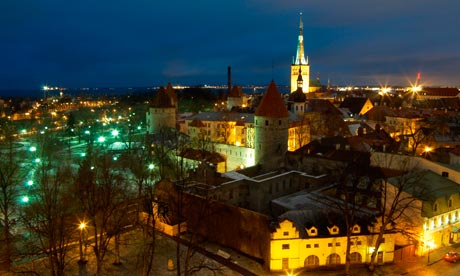
Estonia's capital Tallinn. A 2005 poll found that only 16% of Estonians believed in God. Photograph: Ilja Dubovskis/Alamy

Estonia and the Czech Republic are the two nations that often claim to be the least religious in Europe. And they seem to be proud of their unbelief. According to the census of 2000, 29% of the total population considered themselves as adherents of some religion. Almost 14% of them were Lutherans (in the 1930s the percentage of Lutherans was over 80), and about 13% Orthodox Christians divided between two churches: one under the canonical jurisdiction of ecumenical patriarchate and the other under the jurisdiction of Moscow patriarchate.

A Eurobarometer poll in 2005 found that only 16% of the Estonian population believed in God. With this number, Estonia hit the bottom of the list. However, at the same time more than half the population (54%) believed in some sort of spirit or life force. Thus it could be claimed that 70% of the Estonian population are believers, at least in some sense of the word. Professor Grace Davie's description of the British religiosity as"believing without belonging" seems to fit to the Estonian context as well.

The churches are on Sundays mostly empty and the ignorance of religion is widespread. According to the available statistics and surveys, the membership of religious associations in Estonia remains under one fifth of the total population.

Non-Estonians (mainly immigrants of Russian stock) are considerably more religious, and this becomes even more evident among the younger generations. Surveys show that young Estonians in general have become estranged from every form of religion that could be considered as traditional or as religion at all.

For this situation there are several reasons, starting from the distant past (the close connection of the churches with the Swedish or German ruling classes) up to the Soviet-period atheist policy when the chain of religious traditions was broken in most families.

In Estonia religion has never played an important role on the political or ideological battlefield. The institutional religious life was dominated by foreigners until the early 20th century. The tendencies that prevailed in the late 1930s for closer relations between the state and Lutheran church were ended with the Soviet occupation in 1940. While the Roman Catholic church maintained its dissident role in the Soviet countries, the Lutheran church was not successful in this. This might to have to do something with the Lutheran tradition in general as the role of the Lutheran church also in East Germany diminished considerably during the GDR days.

Although there were some clergymen associated with the dissident movement, the churches remained within the limits set for them by the Soviet authorities. The national reawakening in the late 1980s was accompanied with the religious revival. Religion was something that was seen as a connection with the pre-Soviet golden days. However, by the early 1990s the interest in institutionalised religion started to diminish. Currently the Lutheran church, still considered as the most traditional religious institution in Estonia, has fewer members than it had in the first half of the 1980s when the dues-paying membership reached its Soviet nadir.

The big question for the next decades concerning the religious situation in Estonia is what is going to be the future of the Lutheran church? Although it has been the dominant church among Estonians since the Reformation, the vast majority of younger generations have been estranged from it and the membership numbers are declining.

A new phenomenon during the last 15 years has been the rising number of Estonians identifying themselves with a nature-spirituality that could be defined as the Estonian neo-paganism. However, exactly what this is is much more difficult to explain, as it stresses individualism in religious matters. Although the organisation of the neo-pagans claim to represent pre-Christian religious tradition that has been passed from generation to generation through centuries, and dislikes the term neo-pagan, the historical facts do not support its arguments.

Estonian neo-paganism is closely associated with reverence to nature as well as reviving and following the centuries-old folk traditions, such as the lighting of bonfires during the summer solstice.

Reverence for nature and vocal protection of historical sacred groves has given a positive image to the movement and to their religion, known also as the Earth religion. On the other hand, there are not many neo-pagans officially affiliated with the organisation itself, and during the ancient holy days the groves are not filled with people. The claims by the organisation that all of that 54% who said they believed in spirit or life force are followers of old Estonian religious traditions is pure wishful thinking.


Thursday, September 1, 2011

A New Day for Apologetics | Christianity Today | A Magazine of Evangelical Conviction


A New Day for Apologetics | Christianity Today | A Magazine of Evangelical Conviction

There is a new resurgence in the interest of Apologetics. Certainly, the new challenges hat we are facing today were not faced by previous apologists. Although we stand on their shoulders, we must face the new challenges head on, and not rest in past arguments. The enemies of Christianity have learned new tactics, so should we.