Showing posts with label new. Show all posts

Sunday, February 7, 2016

Catch phrases used by believers to allow for false teachings and ideas in the church.

Have you ever faced false teachers and being criticised for it? In my case, this has happen just too often, that is depressing.

Well, Steven Kozar has gathered a list of the most used phrases that those who defend false teachers use against those who point out their teachers' heresies.

Here it's a few of the phrases, and why they are wrong:

1. “You’re just being negative and critical! Don’t you have anything good to say? I can’t believe you’re criticizing (insert famous/popular Christian leader)! At least they’re trying to help-at least they’re doing something! Why can’t you be more positive? I only listen to positive Christians-not haters!” 
Christianity is a specific set of beliefs that is based on one holy book: The Bible. “Sola Scriptura” is the Latin phrase meaning “Scripture Alone.” This principle was firmly established during the Reformation in stark contrast to the Roman Catholic Church, which claimed that church authority (the Pope) was equal to scripture. 
Because we believe the Bible is God’s Word, we must also believe that some ideas are incompatible with the Bible and must be rejected as false. While it’s true that Christians should not be primarily negative and critical people, we should be willing to say negative and critical things about false teachings, because bad doctrine is very harmful-it leads people away from God. The painful reality is that false teachers are great manipulators and they know exactly what to say in order to keep your trust (and keep their money pouring in), so sometimes it’s necessary to say negative and critical things to confront them and their teachings.  The Old Testament prophets, Jesus and all the Apostles did this. 
A lot. 
We should not be primarily thinking “positive versus negative;” instead, we should be thinking, “true versus false.” The Bible is not always a “positive” book because it contains the truth that we need to hear. We humans are like disobedient children who need correction from our Heavenly Father, who loves us enough to tell us the truth.
In Matthew 23:27 Jesus says “Woe to you, scribes and Pharisees, hypocrites! For you are like whitewashed tombs, which outwardly appear beautiful, but within are full of dead people’s bones and all uncleanness.” Gee whiz, Jesus, that’s not very nice; at least the Pharisees were trying to do something.  
2. “But he’s really famous (he has written popular books, has a huge church, has a TV show, etc.), he must know what he’s talking about!” “That many people can’t be wrong!" 
This exposes the common belief that “the group is always right” (my group!); which is like saying “consensus equals truth.” Christians say that they believe the Bible, but too often what they really believe is whatever their “guy” (local pastor, TV preacher, famous author/speaker, etc.) says about the Bible. On top of that, if a local pastor is actually doing a good job of faithfully preaching God’s Word, he’s often being over-ridden by the surrounding culture. 
We have millions of Christians watching 10, 20 or even 30 hours of television per week, yet they don’t have time to read and study the Bible. But when the latest guru comes along with a new method of “hearing from God” they drop everything to “learn the secret;” yet, they’ve neglected God’s Word-the actual words from God. The situation should be seen as utterly absurd, yet since almost everyone behaves and believes this way, it’s been normalized. As a result, false teachers have free reign and a limitless customer base to promote their weird ideas and enrich themselves. 
In Mark 7:7 Jesus says to the Pharisees (quoting Isaiah): “in vain do they worship me, teaching as doctrines the commandments of men.” In Matthew 7:13-14 He says: “Enter by the narrow gate. For the gate is wide and the way is easy that leads to destruction, and those who enter it are many. For the gate is narrow and the way is hard that leads to life, and those who find it are few.”  Jesus is warning us not to follow the teachings of men (even if it’s a NY Times Best-seller!), and not to “go with the group.”  Psalm 118:8 “It is better to take refuge in the LORD than to trust in man.”


Go ahead, read the rest, they are very revealing!

Thursday, January 7, 2016

Judaism described in the New Testament - Interview by Lawrence H. Schiffman

Bernard Starr, of the Huffington Post has done a superb interview to Lawrance H. Schiffman, on how the New Testament describes Jewish practices and beliefs of the Second Temple Judaism period.

Here it's a piece of the interview:

Q. The Sabbath mandate for rest and renewal in Jewish law and tradition invokes many restrictions on activities---particularly work. Acts 1:12 mentions the allowable distance one can walk on the Sabbath before it is considered a violation. Didn't Jews always know and practice that?
A
. Yes and No. Yes we know about that law, but some say that these particular Sabbath laws only came into existence after the destruction of the Second Temple. But here we have verification that the laws existed in Jesus' time in the first century--- and that the disciples were scrupulously following Jewish law. In Acts 1:12 they were able to walk to the Mount of Olives (Olivet) on the Sabbath because it was in the allowable distance --"A Sabbath day's Journey away" of 3000 ft (2000 cubits). In fact, archaeological excavations have uncovered stones in some locations for marking the Sabbath limits. . 

It's an interesting read. Go ahead and have a look. You will learn heaps. 

Sunday, January 3, 2016

Helmut Koester has passed away

One of the greatest expositor of New Testament and Early Christianity,  Helmut Koester has died.

This is a small obituary:

One of the nation’s foremost scholars of the New Testament and early Christianity, Helmut Koester began teaching at Harvard Divinity School in 1958, and continued to teach at both HDS and the Harvard Extension School through the fall of 2014. He received the Petra T. Shattuck Excellence in Teaching Award in 2005. From 1975 to 1999 he was editor of the journalHarvard Theological Review, and he served for many years as co-editor and chair of the New Testament editorial board of the Hermeneia series, a critical and historical commentary on the Bible published by Fortress Press. His books include the two-volume Introduction to the New Testament (New York: De Gruyter, 1982, second edition, 1995 and 2000), Ancient Christian Gospels: Their History and Development (London: SCM Press and Philadelphia: Trinity Press International, 1990), Paul and His World: Interpreting the New Testament in Its Context(Minneapolis: Fortress Press, 2007); and From Jesus to the Gospels: Interpreting the New Testament in Its Context (Minneapolis: Fortress Press, 2007).


His contribution to New Testament studies will be felt for sure, in generations to come.

May the Lord give rest to his servant.

You can see him in action in the following video, from 2008.

Sunday, November 8, 2015

The New Calvinism

This article was published in TIME magazine more than 6 years ago, and I am happy that it's still on their archives.

Just in case they take the decision to take it down, I am posting it here, for later reference.
===================================================================

If you really want to follow the development of conservative Christianity, track its musical hits. In the early 1900s you might have heard "The Old Rugged Cross," a celebration of the atonement. By the 1980s you could have shared the Jesus-is-my-buddy intimacy of "Shine, Jesus, Shine." And today, more and more top songs feature a God who is very big, while we are...well, hark the David Crowder Band: "I am full of earth/ You are heaven's worth/ I am stained with dirt/ Prone to depravity."
Calvinism is back, and not just musically. John Calvin's 16th century reply to medieval Catholicism's buy-your-way-out-of-purgatory excesses is Evangelicalism's latest success story, complete with an utterly sovereign and micromanaging deity, sinful and puny humanity, and the combination's logical consequence, predestination: the belief that before time's dawn, God decided whom he would save (or not), unaffected by any subsequent human action or decision.
Calvinism, cousin to the Reformation's other pillar, Lutheranism, is a bit less dour than its critics claim: it offers a rock-steady deity who orchestrates absolutely everything, including illness (or home foreclosure!), by a logic we may not understand but don't have to second-guess. Our satisfaction — and our purpose — is fulfilled simply by "glorifying" him. In the 1700s, Puritan preacher Jonathan Edwards invested Calvinism with a rapturous near mysticism. Yet it was soon overtaken in the U.S. by movements like Methodism that were more impressed with human will. Calvinist-descended liberal bodies like the Presbyterian Church (U.S.A.) discovered other emphases, while Evangelicalism's loss of appetite for rigid doctrine — and the triumph of that friendly, fuzzy Jesus — seemed to relegate hard-core Reformed preaching (Reformed operates as a loose synonym for Calvinist) to a few crotchety Southern churches.
No more. Neo-Calvinist ministers and authors don't operate quite on a Rick Warren scale. But, notes Ted Olsen, a managing editor at Christianity Today, "everyone knows where the energy and the passion are in the Evangelical world" — with the pioneering new-Calvinist John Piper of Minneapolis, Seattle's pugnacious Mark Driscoll and Albert Mohler, head of the Southern Seminary of the huge Southern Baptist Convention. The Calvinist-flavored ESV Study Bible sold out its first printing, and Reformed blogs like Between Two Worlds are among cyber-Christendom's hottest links.
Like the Calvinists, more moderate Evangelicals are exploring cures for the movement's doctrinal drift, but can't offer the same blanket assurance. "A lot of young people grew up in a culture of brokenness, divorce, drugs or sexual temptation," says Collin Hansen, author of Young, Restless, Reformed: A Journalist's Journey with the New Calvinists. "They have plenty of friends: what they need is a God." Mohler says, "The moment someone begins to define God's [being or actions] biblically, that person is drawn to conclusions that are traditionally classified as Calvinist." Of course, that presumption of inevitability has drawn accusations of arrogance and divisiveness since Calvin's time. Indeed, some of today's enthusiasts imply that non-Calvinists may actually not be Christians. Skirmishes among the Southern Baptists (who have a competing non-Calvinist camp) and online "flame wars" bode badly.

Calvin's 500th birthday will be this July. It will be interesting to see whether Calvin's latest legacy will be classic Protestant backbiting or whether, during these hard times, more Christians searching for security will submit their wills to the austerely demanding God of their country's infancy.

Monday, September 15, 2014

The Journal of New Testament Studies has made some of its articles for free for a limited time

This is a good opportunity to get hold of of scholarly articles. This offer will not last for ever, but will end at the end of the year.

So, go to the address by clicking here.

This is the first article I've got from the website, and it's extremely important and interesting. Click to find out what it is here.

Monday, August 5, 2013

Saturday, July 20, 2013

Itinerary for the Society for New Testament Studies in Perth, Australia

Seminars

  1. Christliche Literatur des späten ersten Jahrhunderts und des zweiten Jahrhunderts / Christian Literature of the late first century and the second century

    Conveners: Prof. F. Prostmeier, Prof. W. Pratscher and Prof. J. Kelhoffer. Terminates in 2014
    Wed: Wilhelm Pratscher (Vienna), "Motive paulinischer Theologie im 2. Clemensbrief"
    Thu: Ferdinand R. Prostmeier (Freiburg): "Geistig-soziale Milieus des Diskurses über "Religion" in der frühen Kaiserzeit"
    Fri: Vicky Balabanski (Adelaide) "Cosmological categories and the writings of Ignatius of Antioch: Reflections on Trallians 5 and Ephesians 19"
  2. The Dead Sea Scrolls in Relation to Early Judaism and Early Christianity (5*)

    Conveners: Prof. J.J. Collins and Prof. J. Frey. Terminates in 2013.
    This seminar will meet jointly with Seminar 5 (Johannine Writings) in 2013.
     
    Wed: Harry Attridge (Yale): “The Making of Disciples: Predestination in the
    Scrolls and the Fourth Gospel”
    Thu: Hermann Lichtenberger (Tübingen):”Tempel und Tempelmetaphorik
    in Texten vom Toten Meer und im Johannesevangelium”
    Fri: John J. Collins (Yale) and Jörg Frey (Zürich) will each present a review
    of the book by Mary L. Coloe / Tom Thatcher (eds.), John, Qumran, and the
    Dead Sea Scrolls. Sixty Years of Discovery and Debate, SBLEJL 32, Atlanta: SBL 2011
  3. [The Greek of the New Testament]

    Conveners: Prof. C. C. Caragounis and Prof. J. W. Voelz. Terminates in 2014.
    This seminar will not meet in Perth.
  4. Inhalte und Probleme einer neutestamentlichen Theologie

    Conveners: Prof. C. Landmesser and Prof. M. Seifrid. Terminates in 2014.

    Wed: Brendan Byrne, S.J. (Melbourne): "Jerusalems Above and Below: Revisiting the Hagar-Sarah Allegory (Gal 4:21—5:1) and Paul’s View of Non-Messianic Judaism"
    Thu: Dorothy Lee (Melbourne): "Law, Grace and Truth: The Symbolic Role of Moses in Johannine Christology"
    Fri: Brian Rosner (Melbourne): "Paul and the Law: A Hermeneutical Solution to the Puzzle"
  5. The Johannine Writings (2*)

    Conveners: Prof. M. Gruber and Prof. Ch. Karakolis. Terminates in 2015.
    This seminar will meet jointly with Seminar 2 (Dead Sea Scrolls) in 2013. Sign up for Seminar 2.
  6. The Jewish World in New Testament Times (11*)

    Conveners: Prof. S. Freyne, Prof. J.W. van Henten, Prof. W. Horbury. Terminates in 2013.
    This seminar will meet jointly with Seminar 11 (Jewish Theologies). Sign up for Seminar 11.
  7. The Origins and Development of the Jesus Tradition

    Conveners: Prof. T. Holmén and Prof. S.E. Porter. Terminates in 2017.

    Wed: Michael F. Bird (Melbourne): “Why the 'Jesus Tradition'? Its Purpose and Preservation”
    Thu: Craig L. Blomberg (Littleton, Colorado): “When Occam's Razor Shaves Too Closely: A Necessarily Complex Model of the Development of the Jesus Tradition”
    Fri: Paul Foster (Edinburgh): “Memory, Orality, and the Fourth Gospel: Three Dead-Ends in Historical Jesus Research”
  8. The Mission and Expansion of Earliest Christianity

    Conveners: Prof. Eugene Eung-Chun Park, Prof. Paul Trebilco, and Prof. Gosnell Yorke. Terminates in 2015.
     
    Wed: Eugene Eung-Chun Park (San Anselmo, CA): “The itinerant philosophers in the Cynic literature and the Galilean wandering missionaries in the Gospel of Matthew”; respondent: Manabu Tsuji (Hiroshima)
    Thu: Eric Wong (Hong Kong): “Mission – The Reception of Paul in the Synoptic Gospels”
    Fri: Mark Keown (Auckland): "Paul's Vision of Evangelisation and the Church: Taking the debate forward"
  9. Christian Apocryphal Literature

    Conveners: Prof. T. Nicklas, Prof. C.M. Tuckett and Prof. J. Verheyden. Terminates in 2015.

    Wed: Francis Watson (Durham): “Harmony or Gospel: On the Genre of the Diatessaron”
    Thu: Majella Franzmann (Perth): “Johannine Material in the Manichaean Psalm Book”
    Fri: Claire Clivaz (Lausanne): “New Testament Apocrypha and the Emergence of the New Testament Canon. A Research Project by Tobias Nicklas and Claire Clivaz”
  10. Social History and the New Testament

    Conveners: Prof. H. Löhr, Prof. M. Öhler, and Prof. A. Runessen. Terminates in 2014.

    Wed: Albert Harrill (Columbus OH):“Ethnic Fluidity in Ephesians”.
    Thu: Kathy Ehrensperger (Lampeter): “Shared Culture and Diverse Ethnic Identities: The Pauline Discourse of Israel and the Nations”
    Fri: Anders Runesson (Hamilton ON): “The Impact of Ethnic Identity on Theology and Salvation in Matthew’s Gospel”
  11. Jewish Theologies and the New Testament (6*)

    Conveners: Prof. J. Herzer and Prof. G. Oegema. Terminates in 2014.
    This seminar will meet jointly with Seminar 6 (Jewish World).
     
    Wed: John J. Collins (Yale): "The Law of Moses and Jewish Identity in the Second Temple Period"
    Thu: Dieter Sänger (Kiel): "Man ist, was man isst. Speisegebote und jüdische Identität in Joseph und Aseneth"
    Fri: Roland Deines (Nottingham): "Righteousness in the Psalms of Solomon: Reading the Psalms of Solomon as a Book"
  12. Reconsidering Literarkritik of the Pauline Letters and its Impact on their Interpretation

    Conveners: Prof E-M. Becker and Prof. R. Bieringer. Terminates in 2015.
    The seminar will focus on 1 Corinthians, 2 Corinthians, and Philippians.

    Wed: Geoffrey Dunn (Brisbane): "The Letter 'Credebamus post' from Boniface I or Leo I?"
    Thu: Malou Ibita (Leuven/Manila): “The Story of Paul and the Corinthians’ Ongoing Reconciliation:
    A Narrative-Critical Reading of 2 Corinthians 1-7”
    Fri: Sean Winter (Melbourne): “Re-framing the Unity Debate: The Rhetorical Situation of Canonical 2 Corinthians”
  13. Matthew in Context: an Exploration of Matthew in Relation to the Judaism and Christianity of its Time

    Conveners: Prof M. Konradt, Prof. W. Kraus and Prof. W. Loader. Terminates in 2015.
      
    Each paper addresses the issue: What light does Matthew’s use of Mark in relation to the topic throw on Matthew’s theological location?
    Wed: Boris Repschinski (Innsbruck): “Ethics and Law”; respondent: Roland Deines (Nottingham).
    Thu: Edwin Broadhead (Berea): “Discipleship and Ecclesiology”; respondent: Amy-Jill Levine (Vanderbilt).
    Fri: Wolfgang Kraus (Saarbrücken): “Matt 16:21 – 18:35”; respondent: David Sim (Melbourne).
  14. Papyrology, Epigraphy and the New Testament

    Conveners: Prof P. Arzt-Grabner and Prof. J.S. Kloppenborg. Terminates in 2013.
     
    Wed: Peter Arzt-Grabner (Salzburg): “The Date of Jesus’ Birth and of His Death: a Contribution from Papyrology”; respondent: Helen Bond.
    Thu: Scott Charlesworth (Sydney): “A Thoroughly Literary Text: the Greek Papyri of the Gospel of Thomas”; respondent: James Harrison.
    Fri: Giovanni Bazzana (Harvard): “Legal Terminology and Violence in Q. The Contribution of Documentary Papyri”; respondent:Christina M. Kreinecker.
  15. Reading Paul’s Letters in Context: Theological and Social-Scientific Approaches

    Conveners: Prof. William Campbell and Prof. Michael Bachmann. Terminates in 2013.
     
    Wed: William S Campbell (Lampeter) "Theological and Social-Scientific Perspectives on 'Being in Christ'"
    Thu: Kar Yong Lim (Malaysia): "Paul's 'Remembering the Poor' as Ritual in the Corinthian Letters"
    Fri: Andrew Clarke (Aberdeen): "The Locus and Scope of Paul's Apostolic Authority"

Tuesday, May 7, 2013

If you are gay and orthodox bishops don't want to ordain you, you can sue them now. Madness

So, if you are gay, and want to be ordained in a denomination that at least yet, doesn't support gay marriage, what you do is to sue the bishop for lack of human rights.


New Zealand became the 13thcountry to legalise same sex marriage two weeks ago. 
This week the Anglican Bishop of Auckland is being taken to the Human Rights Tribunal over allegations he is discriminating against a gay man who wants to become a priest. 
Right Reverend Ross Bay (pictured) has been accused of preventing a gay man entering the Anglican Church's training or discernment programme for priests because he is unmarried and in a sexual relationship with his male partner
Gay activists, anywhere, instead of creating something for themselves, want to take over other institutions, to degrade them. Look at the Boy Scouts in the USA. Instead of creating a Boy Scouts for gays (actually, due to their lack of reproduction that will never happen), they want to join the lines of the Boys Scouts. 

This is the same situation in the Anglican church. Gays may as well, now that they have total freedom, make a church of their own (they have some of them already) and start proclaiming their degraded message.

The complainant, who cannot be named for legal reasons, said he had been signalling his desire to train for the priesthood since 2006, but had never been accepted into the programme. 
Bay, who approves entrants to the Anglican Church's clergy training programme, has been the Bishop of Auckland since 2010.
 Well, just as adulterers are not accepted in the program, or any other who doesn't live up to God's standards should not be ordained, or at least, someone who recognises that their life style is so much against God's Word, should not be ordained so lightly. But this people, just want to be "affirmed" in their sinful lifestyle. 

The case is illustrative of the sort of litigation that will become commonplace once same sex marriage is legalised. 
At the end of the day this is not about ‘legal equality’ – already granted by civil partnerships – or ‘love’ – nothing currently stands in the way of such relationships.
It is largely about the desire for affirmation and recognition.
 
What infuriates and drives some sections of the gay rights lobby is the fact that some other members of society - in this case leaders in the Anglican church - refuse to accept, affirm and celebrate their sexual relationships. 
And so in complete disregard of the directive of Jesus and Paul not to take fellow Christians to court (Matthew 18:15-17; 1 Corinthians 6:5-7) they end up doing just that – thus underlining the key issue at stake in this debate – a disregard for biblical authority.
So many christians were duped into believing that gay marriage would bring "equality" and  would not interfere with other's liberties, but this case shows the gay agenda, and what some had been saying that such a change in the law and views, would ultimately be (liberal) christianity's doom.

In conclusion, these people don't accept christianity's view on sexuality, or the command to avert court.

These people don't care about Scripture, or God, period.

Liberal Christianity, you assured all that this wouldn't happen. yet, it didn't take that long for bible loving christians to be proved right.


Saturday, April 6, 2013

Top scholars including N.T. Wright headed to Australia in July


NEWS | Sophie Timothy
Thursday 4 April 2013
Writer and popular New Testament theologian N.T. Wright will be among hundreds of scholars visiting Perth in July for the largest gathering of New Testament specialists ever to be held in the southern hemisphere.
It will be the first time the Society for New Testament Studies has met in Australasia, and a number of local scholars have been selected to present papers alongside their international counterparts.  Among them are Ridley Melbourne’s Principal Brian Rosner (formerly of Moore College, Sydney) and Theology Lecturer Mike Bird (previously of Queensland Theological College).
Mike is currently working on a New Testament Introduction co-authored with N.T. Wright and he’s organised for N.T. Wright to spend a week in Melbourne before heading to Perth.
N.T. Wright will speak at three public conferences in Melbourne during the week of July 16-20, the first of which will be held at Ridley, where he will speak on “Paul, Jesus, and the Mission of God’s People”, while the second conference is based on his new book: “Paul and the faithfulness of God”. He’ll then finish his visit to Melbourne with some filming and a two-day conference for the Uniting Church of Australia on “Wisdom’s Feasts” before leaving for Perth.
N.T. Wright is a Professor of New Testament and Early Christianity at the University of St Andrews, Scotland, and was the Bishop of Durham until 2010.  Not afraid to challenge the status quo, N.T. Wright has made ripples in evangelical circles in the last 20 years by questioning the reformed/traditional understanding of the relationship between salvation and the law in the Apostle Paul’s writings. This so-called “New Perspective” aims to take into account a more positive view of Jewish beliefs at the time of Christ. The traditional view is seen as oversimplifying their relationship to God, as based on keeping the law. The most outspoken critics of the New Perspective include John Piper and D.A. Carson. It is a topic which will no doubt be canvassed during Tom’s time in Melbourne.

Saturday, December 29, 2012

Buying Christianity Today's book of the year

If you want to get into real biblical theology, let me commend you to buy the following book:
A New Testament Biblical Theology, A: The Unfolding of the Old Testament in the New by G. K. Beale.


If you click the link, you will be helping for the upkeep of this blog. 

Friday, November 9, 2012

You don't need to be Blasphemous to bring more customers

And that's exactly a cafe in New Zealand has done:


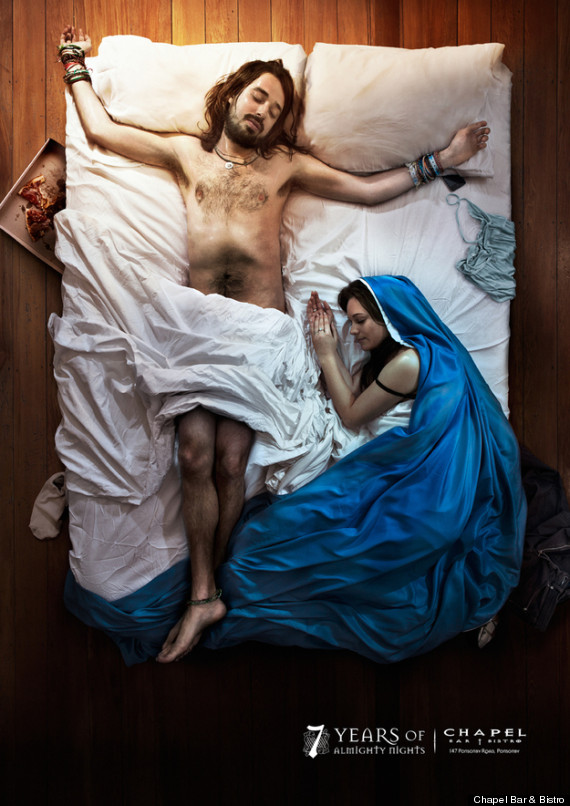
With a name like Chapel Bar & Bistro, one can assume its advertisements would take on a religious motif. What some may interpret as clever allusion, others may interpret as blasphemy. 
Chapel Bar & Bistro, located in Ponsonby, a suburb of Auckland, New Zealand, is celebrating its seventh anniversary. In honor of "seven years of almighty nights," Chapel released an ad depicting "Jesus" and "Mary" in a compromising position.

And apparently this is not the first time they show their idiocy:
Chapel has used religious imagery in its advertisements before. Previous ads showed Jesus and Mary in stained glass with pizza pies as halos and dinner and drinks deals written in scripture scrolls.
But those who are asking for liberty of expression, whatever the expression may be, are also awarding the depiction of the Christian's saviour in such a manner:
The shocking ads may be working. Owner Luke Dallow says Chapel has been"creating miracles since 2005," with a string of devoted celebrity and local fans, and various awards to its name, according to Voxy.
Those who want liberty to advertise, should be more bold. Put Mohammed in a compromising position, and watch your establishment burn the next day.

Christians are easy targets, and don't have any protection from the government. But hey, some of us are so much into defending others, that we forget to defend our own. We deserve it, in a way.

Saturday, September 15, 2012

Calvinsim: more like Schmalvinism!


Written by: Simon on 23/06/2012.
Calvinism must be one of the most overused and abused terms going around in church circles. Much of what I say below I really mean, but it is rather tongue-in-cheek. Also, the way I box people into categories is very fluid, as I will explain later. Finally, I should also apologise to anyone who goes by the name Schmalvin; any confusion is completely unintended.
There are quite a number of streams of Calvinism. Each of the groups I describe below all locate themselves in the theological heritage of the French Protestant reformer, John Calvin. It is very confusing. I hope this helps.
You have the New Calvinists: John Piper is like the grandfather, Mark Driscoll, Matt Chandler and co. are the hipsters who tow the line behind him and a few other grandfather figures. They are the world’s biggest fans of the TULIPacronym. You may have heard the phrase “5 Point Calvinism” thrown around. Most of these people say they are Calvinists, and then you usually discover that they are “4 points Calvinists,” or “4-and-a-half-point Calvinists.” John Piper is a 17 point Calvinist, I think. I suppose that the MacArthur-peddling boys at Team Pyro would fit into this category as well. They tend to be Baptists. Their books get endorsed by D. A. Carson, J. I. Packer and Albert Mohler.
Then you have the Neo-Calvinists. The confusing thing about that title is that “neo” means “new” and so you have two types or Neo-Calvinists floating around. It’s like R. C. Sproul, and R. C. Sproul Jr. More on them later. These Neo-Calvinists descend from the Dutch Calvinist stream, whose figurehead isAbraham Kuyper. Modern exponents include Douglas Wilson, philosopher Nick Wolterstorff, R. C. Spoul Jr, and less explicitly, Tim Keller. They like to use snappy catch-phrases like “All of life under Christ” and use crazy terminology like “sphere sovereignty.” They also emphasise having a Christian worldview, Christian education, and the story arc of the Bible being “Creation-Fall-Redemption-Consumation.”
There are also those whom I enjoy labeling Grumpy Calvinists. I include folk like D. G. Hart, Michael Horton and the White Horse Inn guys, and Carl Truman in this lot. These folk enjoy pointing out everyone else’s shortcomings as Calvinists/Reformed Christians. They tend to freak out about the Neo-Calvinists being too interested in politics and cultural engagement, and they get annoyed by the New Calvinists being not really that Calvinist. They quote the Westminster Confession a lot, and talk about Two-Kingdom theology like it is their theological grid for everything. They also like quoting J. Gresham Machen.
Finally, there’s all of those people who follow the thought of Calvin who either don’t realise it, don’t make a big fuss about it, or don’t care. I would call them the Comfortable Calvinists. They don’t tend to feel the need to prove their ‘Reformed-ness” by arguing with everyone else about how un-reformed they might be. I would say that people like Kevin de Young, the lads over at theCalvinist International, R. C. Sproul, John Frame, and J. I. Packer could be included here.
All of that being said, some of these parties overlap, and individuals who sit under one banner might also happily sit under more than one banner. It is also worth noting that even though these camps might have a dig at each other, they often share the podium at conferences and dialogue about various issues very helpfully. They have more in common than it appears. I have learnt a stack from all of the above-named people, and others within each of the Calvinist camps.
That’s it. Enjoy continuing to be confused.

Monday, June 18, 2012

For those those who still say that gay marriage or gay rights won't affect others...


The New Mexico Court of Appeals has upheld a ruling that a professional photographer who refused to take pictures of a gay couple's commitment ceremony violated state anti-discrimination laws.  The Albuquerque Journal (http://bit.ly/JSAdE5 ) reports the court agreed on Thursday with a previous ruling, ruling the photo studio is considered public, similar to a restaurant or store.  The New Mexico Human Rights Commission ruled in 2008 that Elane Photography violated the state Human Rights Act by discriminating against Vanessa Willock on the basis of sexual orientation. The photography studio says its refusal was not an act of discrimination, but a reflection of the owners' religious and moral beliefs.
So next time somebody tells you that your moral and religious won't be trampled if gay marriage or "marriage equality" comes into place, just don't believe them. They know what we know, yet, they want to play blind to the truth that those who object, will be silenced, prosecuted, jailed, etc. 

This the reasoning of the judges:
The studio asked hypothetically whether an African-American photographer would be required to photograph a Ku Klux Klan rally.The court responded: "The Ku Klux Klan is not a protected class. Sexual orientation, however, is protected."

So, if the Nazis take over, and are protected, it will be not good to bring a class action against them, due to their "political orientation"???

Oh Lord, how far has society come to non-sense!!

Monday, June 11, 2012

Gaga gets wacked in the head while singing her blasphemous song

Hey, I am not happy of anybody getting heart, but she was asking for it.

Besides, she gets hit so hard, she doesn't stop singing!! Sounds more like lip synching to me.

Thursday, May 24, 2012

Homosexuality, yet again!

I have a friend that tells me that talking about gays and homosexuality is my favorite subject. Well, it's not my favourite subject, is actually Jesus. But there is no place or time where I am at, that the homosexuality issue raises its head.

On this subject, Albert Mohler, the president of the Southern Baptist Seminary, has written for CNN, and I would like to share with you this piece. This will help to to answer the objections and also point a way forward when this issue comes up in conversations and places that you visit.

Without further delay, here it's the article.

My Take: The Bible condemns a lot, but here's why we focus on homosexuality 
Editor's Note: R. Albert Mohler Jr. is president of the Southern Baptist Theological Seminary, the flagship school of the Southern Baptist Convention and one of the largest seminaries in the world.

By R. Albert Mohler Jr., Special to CNN
Are conservative Christians hypocritical and selective when it comes to the Bible’s condemnation of homosexuality? With all that the Bible condemns, why the focus on gay sex and same-sex marriage?
 
Given the heated nature of our current debates, it’s a question conservative Christians have learned to expect. “Look,” we are told, “the Bible condemns eating shellfish, wearing mixed fabrics and any number of other things. Why do you ignore those things and insist that the Bible must be obeyed when it comes to sex?” 
On its face, it’s a fair question. But it can be posed in two very different ways.
First, the question can be asked to suggest that the Bible’s clear condemnation of sexual sins can simply be set aside. The other way of posing the question represents a genuine attempt to understand how the Bible is to be rightly applied to life today.
 
In truth, those asking the question the first way really don’t want an answer.
An honest consideration of the Bible reveals that most of the biblical laws people point to in asking this question, such as laws against eating shellfish or wearing mixed fabrics, are part of the holiness code assigned to Israel in the Old Testament. That code was to set Israel, God’s covenant people, apart from all other nations on everything from morality to diet.
 
As the Book of Acts makes clear, Christians are not obligated to follow this holiness code. This is made clear in Peter’s vision in Acts 10:15. Peter is told, “What God has made clean, do not call common.” 
In other words, there is no kosher code for Christians. Christians are not concerned with eating kosher foods and avoiding all others. That part of the law is no longer binding, and Christians can enjoy shrimp and pork with no injury to conscience. 
The Bible’s commands on sexual behavior, on the other hand, are continued in the New Testament. When it comes to homosexuality, the Bible’s teaching is consistent, pervasive, uniform and set within a larger context of law and Gospel. 
The Old Testament clearly condemns male homosexuality along with adultery, bestiality, incest and any sex outside the covenant of marriage. The New Testament does not lessen this concern but amplifies it. 
The New Testament condemns both male and female homosexual behavior. The Apostle Paul, for example, points specifically to homosexuality as evidence of human sinfulness. His point is not merely that homosexuals are sinners but that all humanity has sinned and fallen short of the glory of God. 
The New Testament condemns a full range of sexual sins, and homosexuality is specified among these sins. In Romans, Paul refers to homosexuality in terms of “dishonorable passions,” “contrary to nature” and “shameless.” As New Testament scholar Robert Gagnon has stated, the Bible’s indictment “encompasses every and any form of homosexual behaviour.” 
Some people then ask, “What about slavery and polygamy?” In the first place, the New Testament never commands slavery, and it prizes freedom and human dignity. For this reason, the abolitionist movement was largely led by Christians, armed with Christian conviction. 
The Old Testament did allow for polygamy, though it normalizes heterosexual monogamy. In the New Testament, Jesus made clear that marriage was always meant to be one man and one woman. 
“Have you not read that He who created them made them male and female?” Jesus asked in Matthew. "Therefore a man shall leave his father and his mother and hold fast to his wife, and they shall become one flesh.” For this reason, Christians have opposed polygamy on biblical grounds. 
Why are Christians so concerned with homosexuality? In the first place, that question is answered by the simple fact that it is the most pressing moral question of our times. Christians must be concerned about adultery, pornography, injustice, dishonesty and everything the Bible names as sin. But when my phone rings with a call from a reporter these days, the question I am asked is never adultery or pornography. It is about homosexuality. 
Christians who are seriously committed to the authority of the Bible have no choice but to affirm all that the Bible teaches, including its condemnation of homosexuality. At the same time, our confidence is that God condemns those things that will bring his human creatures harm and commands those things that will lead to true human happiness and flourishing. 
In other words, we understand that the Bible condemns all forms of sin because our Creator knows what is best for us. The Bible names sins specifically so that each of us will recognize our own sinfulness and look to Christ for salvation and the forgiveness of our sins. 
Christian love requires that we believe and teach what the Bible teaches and that we do so with both strong conviction and humble hearts. The Church must repent of our failures in both of these tasks, but we must not be silent where the Bible speaks. 
Are Christians hypocrites in insisting that homosexual behavior is sin? We, too, are sinners, and hypocrisy and inconsistency are perpetual dangers. 
The church failed miserably in the face of the challenge of divorce. This requires an honest admission and strong corrective. 
At the same time, this painful failure must remind us that we must not fail to answer rightly when asked what the Bible teaches about homosexuality. Love requires us to tell the truth. 
The opinions expressed in this commentary are solely those of R. Albert Mohler Jr.

Thursday, March 8, 2012

Tuesday, February 21, 2012

Lowering the flag has lost all its meaning if we don't do it for real heroes

I have not blogged about Whitney Houston's dead because most people that I know have saturated their blogs, Twitter feeds and Facebook Walls talking about her dead as it's the end of the world. Well, I am sorry, I liked her a lot, but it's not the end of the world.

But when you elevate Whitney, or any other celebrity to the level of a soldier, who fights for the freedom of a country, and sacrifices his life for it, that's disgusting. I would do have great respect for fire fighters, cops, and even some doctors, but not Whitney Houston. She died, as Jim West  has already said,


It cheapens the meaning of the respect duly shown to those who have died in service to others.  Whitney Houston died, and it's a tragedy, but she didn't die on some field of battle or fighting some horrible blaze: she died from excessive self indulgence.  That hardly merits the same respect soldiers and patriots are shown.

But read at what a parent of a fallen soldier did upon hearing what the Governor of New Jersey ordered to remember the death of Whitney Houston:
When John Burri heard that New Jersey ordered flags flown at half-staff to honor Whitney Houston, he drove to his local Flags Unlimited store, bought a New Jersey state flag, brought it to his Michigan home, and burned it on his outdoor grill. "It was $12.95 and it was the best money I ever spent," says the father of Army Spc. Eric Burri, who was killed in Iraq in 2005. Michigan's governor ordered that state's flags flown at half-staff for one day to honor Burri's son, and it's an honor that should be reserved for those who died in the line of service, Burri says.
This type of events should be guarded, so they don't lose their cultural meaning. If we start to lower the flag for someone who dies of a drug overdose, or too much drinking, or indulging themselves, we are cheapening the act. What did Whitney fight for? I liked her music, but I don't think she deserves to be put on par with those who have given the ultimate sacrifice.
For New Jersey Gov. Chris Christie to order the same honor for Houston is "a slap in the face," Burri tells the Detroit News. "It cheapens the meaning of lowering that flag. They're watering down the meaning of a hero." His action was a legal one, a law professor notes, since the Supreme Court has ruled that the burning of a US flag is constitutionally protected speech—and those decisions would also apply to state flags. Christie was criticized by others for his decision, but he defended it last week, calling Houston a "cultural icon" of whom New Jersey residents are proud.
So "cultural icons" get the same honour as those who put their lives on the line? Despicable way of thinking, and Gov. Christie should apologize to those he has offended. 

Whitney, I liked you, but you have no place among the real heroes of this world.

Monday, February 20, 2012

The Wallace / Ehrman Debate Online

This is a good resource, but Wallace claims to have a 1st century copy of Mark. This has created a bit of confusion, but still good to look at.