Showing posts with label Calvin. Show all posts

Sunday, November 8, 2015

The New Calvinism

This article was published in TIME magazine more than 6 years ago, and I am happy that it's still on their archives.

Just in case they take the decision to take it down, I am posting it here, for later reference.
===================================================================

If you really want to follow the development of conservative Christianity, track its musical hits. In the early 1900s you might have heard "The Old Rugged Cross," a celebration of the atonement. By the 1980s you could have shared the Jesus-is-my-buddy intimacy of "Shine, Jesus, Shine." And today, more and more top songs feature a God who is very big, while we are...well, hark the David Crowder Band: "I am full of earth/ You are heaven's worth/ I am stained with dirt/ Prone to depravity."
Calvinism is back, and not just musically. John Calvin's 16th century reply to medieval Catholicism's buy-your-way-out-of-purgatory excesses is Evangelicalism's latest success story, complete with an utterly sovereign and micromanaging deity, sinful and puny humanity, and the combination's logical consequence, predestination: the belief that before time's dawn, God decided whom he would save (or not), unaffected by any subsequent human action or decision.
Calvinism, cousin to the Reformation's other pillar, Lutheranism, is a bit less dour than its critics claim: it offers a rock-steady deity who orchestrates absolutely everything, including illness (or home foreclosure!), by a logic we may not understand but don't have to second-guess. Our satisfaction — and our purpose — is fulfilled simply by "glorifying" him. In the 1700s, Puritan preacher Jonathan Edwards invested Calvinism with a rapturous near mysticism. Yet it was soon overtaken in the U.S. by movements like Methodism that were more impressed with human will. Calvinist-descended liberal bodies like the Presbyterian Church (U.S.A.) discovered other emphases, while Evangelicalism's loss of appetite for rigid doctrine — and the triumph of that friendly, fuzzy Jesus — seemed to relegate hard-core Reformed preaching (Reformed operates as a loose synonym for Calvinist) to a few crotchety Southern churches.
No more. Neo-Calvinist ministers and authors don't operate quite on a Rick Warren scale. But, notes Ted Olsen, a managing editor at Christianity Today, "everyone knows where the energy and the passion are in the Evangelical world" — with the pioneering new-Calvinist John Piper of Minneapolis, Seattle's pugnacious Mark Driscoll and Albert Mohler, head of the Southern Seminary of the huge Southern Baptist Convention. The Calvinist-flavored ESV Study Bible sold out its first printing, and Reformed blogs like Between Two Worlds are among cyber-Christendom's hottest links.
Like the Calvinists, more moderate Evangelicals are exploring cures for the movement's doctrinal drift, but can't offer the same blanket assurance. "A lot of young people grew up in a culture of brokenness, divorce, drugs or sexual temptation," says Collin Hansen, author of Young, Restless, Reformed: A Journalist's Journey with the New Calvinists. "They have plenty of friends: what they need is a God." Mohler says, "The moment someone begins to define God's [being or actions] biblically, that person is drawn to conclusions that are traditionally classified as Calvinist." Of course, that presumption of inevitability has drawn accusations of arrogance and divisiveness since Calvin's time. Indeed, some of today's enthusiasts imply that non-Calvinists may actually not be Christians. Skirmishes among the Southern Baptists (who have a competing non-Calvinist camp) and online "flame wars" bode badly.

Calvin's 500th birthday will be this July. It will be interesting to see whether Calvin's latest legacy will be classic Protestant backbiting or whether, during these hard times, more Christians searching for security will submit their wills to the austerely demanding God of their country's infancy.

Saturday, August 31, 2013

Free Books from Amazon to your Kindle or tablet by Martin Luther and John Calvin

One must take advantage of this offers!!

Click on the pictures to be taken to Amazon. If you have an e-reader, this is a good chance.


Saturday, September 15, 2012

Calvinsim: more like Schmalvinism!


Written by: Simon on 23/06/2012.
Calvinism must be one of the most overused and abused terms going around in church circles. Much of what I say below I really mean, but it is rather tongue-in-cheek. Also, the way I box people into categories is very fluid, as I will explain later. Finally, I should also apologise to anyone who goes by the name Schmalvin; any confusion is completely unintended.
There are quite a number of streams of Calvinism. Each of the groups I describe below all locate themselves in the theological heritage of the French Protestant reformer, John Calvin. It is very confusing. I hope this helps.
You have the New Calvinists: John Piper is like the grandfather, Mark Driscoll, Matt Chandler and co. are the hipsters who tow the line behind him and a few other grandfather figures. They are the world’s biggest fans of the TULIPacronym. You may have heard the phrase “5 Point Calvinism” thrown around. Most of these people say they are Calvinists, and then you usually discover that they are “4 points Calvinists,” or “4-and-a-half-point Calvinists.” John Piper is a 17 point Calvinist, I think. I suppose that the MacArthur-peddling boys at Team Pyro would fit into this category as well. They tend to be Baptists. Their books get endorsed by D. A. Carson, J. I. Packer and Albert Mohler.
Then you have the Neo-Calvinists. The confusing thing about that title is that “neo” means “new” and so you have two types or Neo-Calvinists floating around. It’s like R. C. Sproul, and R. C. Sproul Jr. More on them later. These Neo-Calvinists descend from the Dutch Calvinist stream, whose figurehead isAbraham Kuyper. Modern exponents include Douglas Wilson, philosopher Nick Wolterstorff, R. C. Spoul Jr, and less explicitly, Tim Keller. They like to use snappy catch-phrases like “All of life under Christ” and use crazy terminology like “sphere sovereignty.” They also emphasise having a Christian worldview, Christian education, and the story arc of the Bible being “Creation-Fall-Redemption-Consumation.”
There are also those whom I enjoy labeling Grumpy Calvinists. I include folk like D. G. Hart, Michael Horton and the White Horse Inn guys, and Carl Truman in this lot. These folk enjoy pointing out everyone else’s shortcomings as Calvinists/Reformed Christians. They tend to freak out about the Neo-Calvinists being too interested in politics and cultural engagement, and they get annoyed by the New Calvinists being not really that Calvinist. They quote the Westminster Confession a lot, and talk about Two-Kingdom theology like it is their theological grid for everything. They also like quoting J. Gresham Machen.
Finally, there’s all of those people who follow the thought of Calvin who either don’t realise it, don’t make a big fuss about it, or don’t care. I would call them the Comfortable Calvinists. They don’t tend to feel the need to prove their ‘Reformed-ness” by arguing with everyone else about how un-reformed they might be. I would say that people like Kevin de Young, the lads over at theCalvinist International, R. C. Sproul, John Frame, and J. I. Packer could be included here.
All of that being said, some of these parties overlap, and individuals who sit under one banner might also happily sit under more than one banner. It is also worth noting that even though these camps might have a dig at each other, they often share the podium at conferences and dialogue about various issues very helpfully. They have more in common than it appears. I have learnt a stack from all of the above-named people, and others within each of the Calvinist camps.
That’s it. Enjoy continuing to be confused.

Wednesday, July 11, 2012

Calvin on bold preaching

Some people have taken "offense" that when I preach, I look like I am sure of what I am preaching, as if this is a bad quality. Well, I leave you with the words of John Calvin on the subject:


[H]e [the preacher] should not speak uncertainly as if he were giving out comments of his own, but he should be able to speak out confidently without hesitation in the name of God; just as Jeremiah in this passage [Jer 1] demands to be heard because, as he declares, God has put his words in his mouth.
We can be sure that whatever comes from man’s own cleverness may be ignored. God demands for himself alone the honor of being heard in his church (as I said yesterday). Hence it follows that none should be recognized as servants of God, none should be counted just and faithful prophets or teachers, unless God is speaking through them, unless they invent nothing by themselves and teach nothing by their own will, but preach only what God commands. -- John Calvin

Tuesday, July 10, 2012

Happy B'Day Calvin

Well, it is surprising the him and me were borne in the same month, ten days apart.

To all my Neo-Calvinist friends, I hope you remember that your denomination's founder was borne today.

Anyway, Happy B'Day Calvin, and thank you for your contribution to Christianity:

Monday, June 25, 2012

Word of Comfort

All I can say, that even though I disagree with Calvin in so many things, it is good to see him used by the Lord to bring to me a word of comfort and hope:


The design of the Lord is to exercise the patience of his servant by adversity; Satan endeavours to drive him to despair-  John Calvin

Tuesday, June 12, 2012

A persecutor on the topic of persecution: John Calvin


If, while conscious of our innocence, we are deprived of our substance by the wickedness of man, we are, no doubt, humanly speaking, reduced to poverty; but in truth our riches in heaven are increased: if driven from our homes we have a more welcome reception into the family of God; if vexed and despised, we are more firmly rooted in Christ; if stigmatised by disgrace and ignominy, we have a higher place in the kingdom of God; and if we are slain, entrance is thereby given us to eternal life. The Lord having set such a price upon us, let us be ashamed to estimate ourselves at less than the shadowy and evanescent allurements of the present life. -- John Calvin

Good on Calvin. He also persecuted some Anabaptists in his day. I just want to see how things go in heaven when he sees the brothers and sisters he sent to heaven, thinking they were going to drawn at the bottom of the Rhone river, and be silenced for ever.

Oh, how wrong you were Calvin!! Still, I like you.  You were a good theologian, but treated some of your brothers with utter contempt. 

Monday, May 21, 2012

John Calvin's on other people's salvation


God speaks to you that you may make the right decision. But God does not satisfy our curiosity as to what happens about other men who do not decide for Christ. What will be the ultimate fate of other men is not your concern; we may not and are not to know that, except in so far as we must realize that it is our duty not only ourselves to remain loyal to the way of Jesus, but as far as possible to help others to find the way that leads to life. It is not the consequence of our superior merit that we ourselves have found this way. We have not come to it because we are better than other people. It is the grace of God which has set our feet in that way. -- John Calvin 

Thursday, April 12, 2012

John Calvin on Music


It is certain that the use of singing in churches (which I may mention in passing) is not only very ancient, but was also used by the Apostles, as we may gather from the words of Paul, “I will sing with the spirit, and I will sing with the understanding also,” (1 Cor. 14:15). In like manner he says to the Colossians, “Teaching and admonishing one another in psalms, and hymns, and spiritual songs, singing with grace in your hearts to the Lord,” (Col. 3:16). In the former passage, he enjoins us to sing with the voice and the heart; in the latter, he commends spiritual Songs, by which the pious mutually edify each other.
That it was not an universal practice, however, is attested by Augustine (Confess. Lib. 9 cap. 7), who states that the church of Milan first began to use singing in the time of Ambrose, when the orthodox faith being persecuted by Justina, the mother of Valentinian, the vigils of the people were more frequent than usual; and that the practice was afterwards followed by the other Western churches. He had said a little before that the custom came from the East.485 He also intimates (Retract. Lib. 2) that it was received in Africa in his own time. His words are, “Hilarius, a man of tribunitial rank, assailed with the bitterest invectives he could use the custom which then began to exist at Carthage, of singing hymns from the book of Psalms at the altar, either before the oblation, or when it was distributed to the people; I answered him, at the request of my brethren.” And certainly if singing is tempered to a gravity befitting the presence of God and angels, it both gives dignity and grace to sacred actions, and has a very powerful tendency to stir up the mind to true zeal and ardor in prayer. We must, however, carefully beware, lest our ears be more intent on the music than our minds on the spiritual meaning of the words.
Augustine confesses (Confess. Lib. 10 cap. 33) that the fear of this danger sometimes made him wish for the introduction of a practice observed by Athanasius, who ordered the reader to use only a gentle inflection of the voice, more akin to recitation than singing. But on again considering how many advantages were derived from singing, he inclined to the other side. If this moderation is used, there cannot be a doubt that the practice is most sacred and salutary. On the other hand, songs composed merely to tickle and delight the ear are unbecoming the majesty of the Church, and cannot but be most displeasing to God (Institutes 3.20.32).

Tuesday, April 3, 2012

The Logos March Madness shows the who is who of evangelical authors

Logos is doing a competition between scholars, and the one that wins, gets its titles reduced (how would the proper scholar feel about that?) up to 75% off a bundle of his books.

This is a very good way to see what authors are having an impact in the evangelical world. It seems that McArthur is not pulling up the punches many would expect.

Piper lost to Packer, and I was expecting Piper to win over Packer. Seems that Packer still has a lot of fans. It is interesting too that Lloyd-Jones beats Spurgeon.

It is telling that in Division 4, where Wright was placed, he battled against ancient people, the likes of Aquinas, Cranfield, and Kuyper. Wright is the only modern/recent scholar who could move to the finals. I would have like to have seen maybe Bauckham also reaching that place, since he is such a good scholar regarding the deity of Jesus, and the identity of God overall.

In Division 3, Calvin fell at the feet of Spurgeon!!!!! This is extremely telling!!!! In my view, this is a reflection of the Neo-Calvinists, that quote Spurgeon time and time again, believing that they are really quoting Calvin through Spurgeon.

Well, vote, have fun, this is a very enlightening ordeal.

Tuesday, January 3, 2012

Reading Calvin through the year

I have made a challenge to myself this year, to read John Calvin's Institutes of the Christian Religion.

I have found many people, mainly young ones, in the internet, that are ardent Calvinists, yet, have never read Calvin.

So, on top of my bible reading, I am challenging me, and you, that we should read Calvin's theology, in order to understand the Reformer better, and not mis-represent him when one is pretending to defend his theology.

Here it is for those interested, and thank you Dr. Jim West for bringing it to my attention.
A Year through Calvin's Institutes (1559) b

Wednesday, October 19, 2011

For those of us interested in Reformation Studies, this series poses a good future resource:

Vandenhoeck & Ruprecht, projectpartner of Refo500, has started a series academic studies focussing on the religious, theological, political, social, legal, and cultural dimensions of the Reformation. In this series, monographs and thematic collections will be published in English, German and French. The series is characterised by an interdisciplinary approach, international cooperation, and a high scholarly level.
Vandenhoeck__Ruprecht.pngForthcoming volumes in 2012Vol. 1: Benjamin T.G. Mayes: Counsel and Conscience. Lutheran Casuistry and Moral Reasoning After the Reformation
Vol. 2: Andreas Beck (Ed.): Melanchthon und die Reformierte Tradition
Vol. 3: Peter Opitz (Ed.): The Myth of the Reformation
Vol. 4: Volker Leppin/Herman Selderhuis: Anti-Calvinismus und Krypto-Calvinismus im konfessionellen Zeitalter
Manuscript proposalsManuscript proposals can be sent to the general editor of the series.
Editorial boardMarianne Carbonnier (Paris)
Günter Frank (Bretten)
Bruce Gordon (New Haven)
Ute Lotz-Heumann (Tucson)
Mathijs Lamberigts (Leuven)
Barbara Mahlmann-Bauer (Bern)
Tarald Rasmussen(Oslo)
Johannes Schilling (Kiel)
Herman Selderhuis (general editor, Emden)
Günther Wassilowsky (Linz)
Siegrid Westphal (Osnabrück)

For more information, see the link.

Friday, October 7, 2011

More thoughts on the Meaning of the Lord’s Supper by Calvin…


Let’s hear what Calvin said on the matter in 1559- 30 years after the colloquy-
The presence of Christ in the Supper we must hold to be such as neither affixes him to the element of bread, nor encloses him in bread, nor circumscribes him in any way (this would obviously detract from his celestial glory); and it must, moreover, be such as neither divests him of his just dimensions, nor dissevers him by differences of place, nor assigns to him a body of boundless dimensions, diffused through heaven and earth.

The ‘Sacraments’ Do Not Confer Grace

As the Consensus Tigurinus rightly declares-
Article 17. The Sacraments Do Not Confer Grace.By this doctrine is overthrown that fiction of the sophists which teaches that the sacraments confer grace on all who do not interpose the obstacle of mortal sin. For besides that in the sacraments nothing is received except by faith, we must also hold that the grace of God is by no means so annexed to them that whoso receives the sign also gains possession of the thing. For the signs are administered alike to reprobate and elect, but the reality reaches the latter only.
 I am not happy at all with the Catholic position on the sacraments, which I see it more like a blasphemy. Many weren't happy with the Lutheran position either. So the Reformed/Calvinistic position served as a via media for the rest of us.

Not all things that Calvin said were wrong. That's why we can't close our minds to either Luther or Calvin, or the Anabaptists for that matter.

Monday, October 3, 2011

Calvin on Spiritual Warfare


I have previously posted of how Luther advised some of his parishioners as to how deal with Satan.

Now, I would like to mention what Calvin says about how to conduct Spiritual Warfare.

Being forewarned of the constant presence of an enemy the most daring, the most powerful, the most crafty, the most indefatigable, the most completely equipped with all the engines and the most expert in the science of war, let us not allow ourselves to be overtaken by sloth or cowardice, but, on the contrary, with minds aroused and ever on the alert, let us stand ready to resist; and, knowing that this warfare is terminated only by death, let us study to persevere. Above all, fully conscious of our weakness and want of skill, let us invoke the help of God, and attempt nothing without trusting in him, since it is his alone to supply counsel, and strength, and courage, and arms. - John Calvin


Well, no farts with Calvin. That's an improvement from Luther!!!

Saturday, September 17, 2011

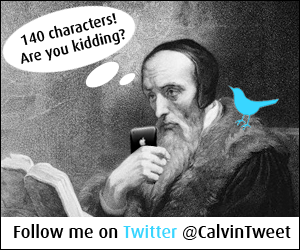
Apparently, there are iPhones in heaven


I have blogged a cartoon on Calvin previously here.

I have found another cartoon, that it's very funny. I wonder if Calvin can truly continue to have a hold on his followers, and un-followers through Twitter.

Seems there is a pseudo-deutero Calvin, I better not join the twitter feed. I don't like talking to the dead.

Friday, September 16, 2011

Europe is not only becoming unchristian, but is going pagan


What happens to a nation when they forsake God? They turn to any other type of belief, of course. Estonia and the Czech are prime examples of this trend, but are not alone in this. There are many countries that are going that guy. Australia is an example of it, even though we may have mega churches like Hill Song, that gives a false impression that the gospel is well and vibrant here. Talking to a Pentecostal pastor today, I was told that once you leave the centres of the cities, Pentecostal churches struggle to survive.

Another thing that worries me, is that those countries that embraced the Protestant Reformation, are also as enthusiastic to disowned it. Take this as an example. In a documentary about the Christian Church on the History Channel presented by Diarmaid McCulloch "A History of Christianity", when the female pastor of Geneve is asked what she thinks about how John Calvin would feel to know that a woman pastor is the one heading his congregation, her answer was "well, that was his time, now this is my time".

Now Geneva is far from the propaganda that John Knox spread during his time, that Calvin's Geneva was "the most perfect school of Christ". The reality is that it never was the most perfect school of Christ. Even when Jesus was with his disciples, and believe me, that was the most perfect school led by the real founder of our faith, they had issues among them. The sad thing of it all, is that Lutheran and Reformed countries never achieved the Reformation they sought, and due to the laziness imbedded in their own traditions-no works, even though after you are saved although you are called to do them but be careful not to over do them just in case you believe that you are doing works to be saved, therefore, don't do anything- has paid out at the end.

Well, you can read the news article, and be informed.

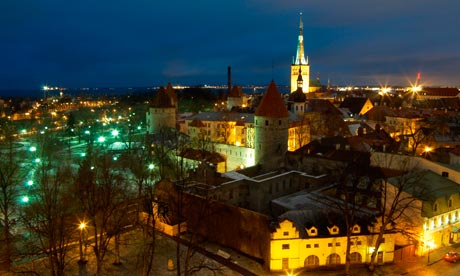
Estonia's capital Tallinn. A 2005 poll found that only 16% of Estonians believed in God. Photograph: Ilja Dubovskis/Alamy

Estonia and the Czech Republic are the two nations that often claim to be the least religious in Europe. And they seem to be proud of their unbelief. According to the census of 2000, 29% of the total population considered themselves as adherents of some religion. Almost 14% of them were Lutherans (in the 1930s the percentage of Lutherans was over 80), and about 13% Orthodox Christians divided between two churches: one under the canonical jurisdiction of ecumenical patriarchate and the other under the jurisdiction of Moscow patriarchate.

A Eurobarometer poll in 2005 found that only 16% of the Estonian population believed in God. With this number, Estonia hit the bottom of the list. However, at the same time more than half the population (54%) believed in some sort of spirit or life force. Thus it could be claimed that 70% of the Estonian population are believers, at least in some sense of the word. Professor Grace Davie's description of the British religiosity as"believing without belonging" seems to fit to the Estonian context as well.

The churches are on Sundays mostly empty and the ignorance of religion is widespread. According to the available statistics and surveys, the membership of religious associations in Estonia remains under one fifth of the total population.

Non-Estonians (mainly immigrants of Russian stock) are considerably more religious, and this becomes even more evident among the younger generations. Surveys show that young Estonians in general have become estranged from every form of religion that could be considered as traditional or as religion at all.

For this situation there are several reasons, starting from the distant past (the close connection of the churches with the Swedish or German ruling classes) up to the Soviet-period atheist policy when the chain of religious traditions was broken in most families.

In Estonia religion has never played an important role on the political or ideological battlefield. The institutional religious life was dominated by foreigners until the early 20th century. The tendencies that prevailed in the late 1930s for closer relations between the state and Lutheran church were ended with the Soviet occupation in 1940. While the Roman Catholic church maintained its dissident role in the Soviet countries, the Lutheran church was not successful in this. This might to have to do something with the Lutheran tradition in general as the role of the Lutheran church also in East Germany diminished considerably during the GDR days.

Although there were some clergymen associated with the dissident movement, the churches remained within the limits set for them by the Soviet authorities. The national reawakening in the late 1980s was accompanied with the religious revival. Religion was something that was seen as a connection with the pre-Soviet golden days. However, by the early 1990s the interest in institutionalised religion started to diminish. Currently the Lutheran church, still considered as the most traditional religious institution in Estonia, has fewer members than it had in the first half of the 1980s when the dues-paying membership reached its Soviet nadir.

The big question for the next decades concerning the religious situation in Estonia is what is going to be the future of the Lutheran church? Although it has been the dominant church among Estonians since the Reformation, the vast majority of younger generations have been estranged from it and the membership numbers are declining.

A new phenomenon during the last 15 years has been the rising number of Estonians identifying themselves with a nature-spirituality that could be defined as the Estonian neo-paganism. However, exactly what this is is much more difficult to explain, as it stresses individualism in religious matters. Although the organisation of the neo-pagans claim to represent pre-Christian religious tradition that has been passed from generation to generation through centuries, and dislikes the term neo-pagan, the historical facts do not support its arguments.

Estonian neo-paganism is closely associated with reverence to nature as well as reviving and following the centuries-old folk traditions, such as the lighting of bonfires during the summer solstice.

Reverence for nature and vocal protection of historical sacred groves has given a positive image to the movement and to their religion, known also as the Earth religion. On the other hand, there are not many neo-pagans officially affiliated with the organisation itself, and during the ancient holy days the groves are not filled with people. The claims by the organisation that all of that 54% who said they believed in spirit or life force are followers of old Estonian religious traditions is pure wishful thinking.


Thursday, July 22, 2010

Iron in our blood. The Evangelical need to pick a fight


I have been reading a very interesting blog, in which I found the following paragraph:
the culture of conservative evangelicals (and especially of the conservatively reformed) is sickening to me. everything is about a battle for x’ or ‘defending the heart of the gospel’ (which changes as the opponent changes…one day it’s justification and n.t. wright is a heretic, the next day it’s inerrancy and kenton sparks is a heretic). that’s not what i want to do with my time. i didn’t go to seminary so that i could get a ‘heresy hunter’ license and claim my spot among machen’s warrior children. i went to seminary because i want to positively contribute to the way christians think about the bible, about their god, and about how to live their lives in relationship to that god.


One can easily get that from listening to the White Horse Inn or Issues Etc. Mind you, I listen to them every week, and in the case of the later, every day. Their shows are interesting, but you just wondered if they ever have a positive view of something that does not involve Calvin, Machen or Luther.

Take for example Issues Etc, if you don't read Scripture under the lenses of Law and Gospel, you are no better than a donkey reading the newspaper, you just won't understand it. But if you if apply the Lutheran Method, then your eyes will be open and then you will understand the message. This sounds to me more like the Jehovah Witness claim about need to read the books written by Russel in order to understand Scripture. I guess both never heard about the guidance of the Holy Spirit!!!

In the case of the New Reformed, if you say that that Reformers' claim that Justification by faith is not the center of the gospel, you may as well reject being a christian. Jesus' proclamation was not that all were saved by justification by faith, which of course, was a central theme that was developed by Paul, but his initial and final instructions were the following:
Mark 1:14.."The kingdom of God is near. Repent and believe the good news!"


and:

Mark 16:15...He said to them, "Go into all the world and preach the good news to all creation.


It looks like Jesus is very consistant about what the gospel was all about, was about the kingdom. Later, and rightly, the other historical aspects were added, cf. I Cor. 15:3-7.

But what I like about the article, is that the author rightly points out that the "heart" of the gospels changes so much, from every "defender" of it, that it looks more like the gospel is an octopus, with many hearts. The octopus has 3, but my neo Reformed friends, and other conservatives, are starting to look like the Roman Catholics at the time of the Reformation, having many of Peter's heads, as well as more bones from the apostles than the apostles themselves had!!!!!!

Sounds like we got rid of some relics, to pick up another ones, more acceptable to their liking. Once the common enemy of the time, the Catholics, were "vanquished", the Protestants turned, and still turned against each other to say to the other that they were wrong. The Reformers would be turning in their graves if they would know what sort of legacy would follow their bible loving, Scripture upholding and true christian followers.

Looks like we have a long way to go in order to reach unity in the body of Christ.

Luis A. Jovel

Sunday, June 13, 2010

Calvin Vs Servet in the Afterlife


A funny cartoon, which I think says a lot of true.

Servet was a heretic by denying the Trinity, yet, he didn't deserve to be killed or to be exiled.

This proved that even the Reformers were victim of what they condemned in the Catholic Church, of intolerance.

Sound like the age of relativism started there and then.