Showing posts with label Europe. Show all posts

Wednesday, October 15, 2014

African Christians don't read African authors - The same goes for Latin Americans.

This blog is written by a Latin American, so many things will have to do with how I see the world from a Latin American perspective.

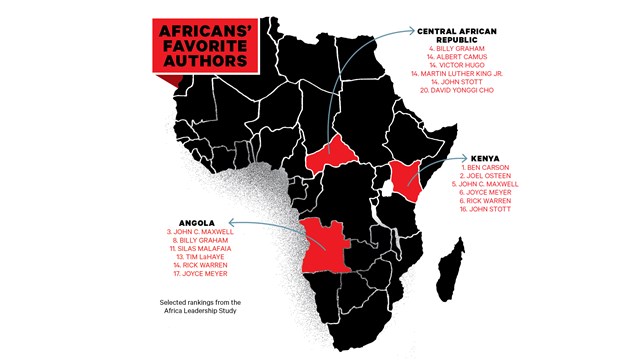
Christianity Today has published an article that mentions how Africans are reading more christian American authors rather than authors from their own continent, that also write christian books. The article gives many reasons why authors from Africa don't feel compelled to write, but it also reflects the interest within the African community about prosperity gospel, and also about how much they know about the American type of Christianity, and how little they know about their own.

In Latin American, we suffer a similar thing. The prosperity Gospel teachers chew books out of the printer regularly. There's also a growing section of Christianity that are reading faithful Christian writers from the USA, Canada, Australia and Europe. This is good, but they don't go beyond that. Some, only read Reformed flavoured literature, and at times, only XVI century writers, that don't relate to the practical pastoral issues being faced in the continent.

This article, along with that particular whole issue of Christianity Today, opens us to the world of how diverse Christianity can be. It's not a sin to be different, if we are still faithful to the word of God.

Thursday, October 11, 2012

The USA is not a Protestant nation anymore

This was long coming. The USA has embraced multiculturalism like Australia has, and therefore, have no backbone in the faith the helped the country.

AP starts its news piece this way:
For the first time in its history, the United States does not have a Protestant majority, according to a new study. One reason: The number of Americans with no religious affiliation is on the rise.
So, it's not that they are turning to Catholicism as some have suggested, but those who are not affiliated with a historical church, or those non-denominational churches, are not considered Protestants at all.


The percentage of Protestant adults in the U.S. has reached a low of 48 percent, the first time that Pew Forum on Religion & Public Life has reported with certainty that the number has fallen below 50 percent. The drop has long been anticipated and comes at a time when no Protestants are on the U.S. Supreme Court and the Republicans have their first presidential ticket with no Protestant nominees. 
Among the reasons for the change are the growth in nondenominational Christians who can no longer be categorized as Protestant, and a spike in the number of American adults who say they have no religion. The Pew study, released Tuesday, found that about 20 percent of Americans say they have no religious affiliation, an increase from 15 percent in the last five years.


Just as Europe is turning more and more secular, the USA has also adopted the same approach, and this is alarming for those who have always considered that the USA is an exceptional nation, because it is, as they say, a Christian nation:
Growth among those with no religion has been a major preoccupation of American faith leaders who worry that the United States, a highly religious country, would go the way of Western Europe, where church attendance has plummeted. Pope Benedict XVI has partly dedicated his pontificate to combating secularism in the West. This week in Rome, he is convening a three-week synod, or assembly, of bishops from around the world aimed at bringing back Roman Catholics who have left the church.
As this trend continues, it is sure to affect the politics of the the USA.
The trend also has political implications. American voters who describe themselves as having no religion vote overwhelmingly for Democrats. Pew found Americans with no religion support abortion rights and gay marriage at a much higher-rate than the U.S. public at large. These "nones" are an increasing segment of voters who are registered as Democrats or lean toward the party, growing from 17 percent to 24 percent over the last five years. The religiously unaffiliated are becoming as important a constituency to Democrats as evangelicals are to Republicans, Pew said. 
There was a belief that the USA was different from Europe, because of its religiosity, that although it was a wealthy nation, it still had a faith to rely on. Well, as the Guardian Newspaper reports, that's only an illusion:
Researchers have been struggling for decades to find a definitive reason for the steady rise in those with no religion. The spread of secularism in western Europe was often viewed as a byproduct of growing wealth in the region. Yet among industrialised nations, the US stood out for its deep religiosity in the face of increasing wealth.

Both news sources point to the fact that there are no Protestants in the Supreme Court, and that the Republican presidential candidates, both are not Protestants. That, in the party that is considered the bastion of Protestantism.

Is this a sign that Protestantism as an experiment has failed? Catholics have not done well either. It is very interesting that such a study comes in the month when Protestantism celebrates its birth!!

Regardless of the final assessment we give to this finding, it shows that the thought of the USA as a Christian nation, is now just a myth.

Friday, September 16, 2011

Europe is not only becoming unchristian, but is going pagan


What happens to a nation when they forsake God? They turn to any other type of belief, of course. Estonia and the Czech are prime examples of this trend, but are not alone in this. There are many countries that are going that guy. Australia is an example of it, even though we may have mega churches like Hill Song, that gives a false impression that the gospel is well and vibrant here. Talking to a Pentecostal pastor today, I was told that once you leave the centres of the cities, Pentecostal churches struggle to survive.

Another thing that worries me, is that those countries that embraced the Protestant Reformation, are also as enthusiastic to disowned it. Take this as an example. In a documentary about the Christian Church on the History Channel presented by Diarmaid McCulloch "A History of Christianity", when the female pastor of Geneve is asked what she thinks about how John Calvin would feel to know that a woman pastor is the one heading his congregation, her answer was "well, that was his time, now this is my time".

Now Geneva is far from the propaganda that John Knox spread during his time, that Calvin's Geneva was "the most perfect school of Christ". The reality is that it never was the most perfect school of Christ. Even when Jesus was with his disciples, and believe me, that was the most perfect school led by the real founder of our faith, they had issues among them. The sad thing of it all, is that Lutheran and Reformed countries never achieved the Reformation they sought, and due to the laziness imbedded in their own traditions-no works, even though after you are saved although you are called to do them but be careful not to over do them just in case you believe that you are doing works to be saved, therefore, don't do anything- has paid out at the end.

Well, you can read the news article, and be informed.

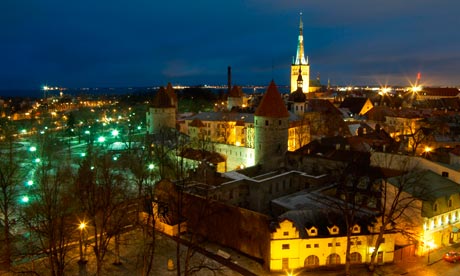
Estonia's capital Tallinn. A 2005 poll found that only 16% of Estonians believed in God. Photograph: Ilja Dubovskis/Alamy

Estonia and the Czech Republic are the two nations that often claim to be the least religious in Europe. And they seem to be proud of their unbelief. According to the census of 2000, 29% of the total population considered themselves as adherents of some religion. Almost 14% of them were Lutherans (in the 1930s the percentage of Lutherans was over 80), and about 13% Orthodox Christians divided between two churches: one under the canonical jurisdiction of ecumenical patriarchate and the other under the jurisdiction of Moscow patriarchate.

A Eurobarometer poll in 2005 found that only 16% of the Estonian population believed in God. With this number, Estonia hit the bottom of the list. However, at the same time more than half the population (54%) believed in some sort of spirit or life force. Thus it could be claimed that 70% of the Estonian population are believers, at least in some sense of the word. Professor Grace Davie's description of the British religiosity as"believing without belonging" seems to fit to the Estonian context as well.

The churches are on Sundays mostly empty and the ignorance of religion is widespread. According to the available statistics and surveys, the membership of religious associations in Estonia remains under one fifth of the total population.

Non-Estonians (mainly immigrants of Russian stock) are considerably more religious, and this becomes even more evident among the younger generations. Surveys show that young Estonians in general have become estranged from every form of religion that could be considered as traditional or as religion at all.

For this situation there are several reasons, starting from the distant past (the close connection of the churches with the Swedish or German ruling classes) up to the Soviet-period atheist policy when the chain of religious traditions was broken in most families.

In Estonia religion has never played an important role on the political or ideological battlefield. The institutional religious life was dominated by foreigners until the early 20th century. The tendencies that prevailed in the late 1930s for closer relations between the state and Lutheran church were ended with the Soviet occupation in 1940. While the Roman Catholic church maintained its dissident role in the Soviet countries, the Lutheran church was not successful in this. This might to have to do something with the Lutheran tradition in general as the role of the Lutheran church also in East Germany diminished considerably during the GDR days.

Although there were some clergymen associated with the dissident movement, the churches remained within the limits set for them by the Soviet authorities. The national reawakening in the late 1980s was accompanied with the religious revival. Religion was something that was seen as a connection with the pre-Soviet golden days. However, by the early 1990s the interest in institutionalised religion started to diminish. Currently the Lutheran church, still considered as the most traditional religious institution in Estonia, has fewer members than it had in the first half of the 1980s when the dues-paying membership reached its Soviet nadir.

The big question for the next decades concerning the religious situation in Estonia is what is going to be the future of the Lutheran church? Although it has been the dominant church among Estonians since the Reformation, the vast majority of younger generations have been estranged from it and the membership numbers are declining.

A new phenomenon during the last 15 years has been the rising number of Estonians identifying themselves with a nature-spirituality that could be defined as the Estonian neo-paganism. However, exactly what this is is much more difficult to explain, as it stresses individualism in religious matters. Although the organisation of the neo-pagans claim to represent pre-Christian religious tradition that has been passed from generation to generation through centuries, and dislikes the term neo-pagan, the historical facts do not support its arguments.

Estonian neo-paganism is closely associated with reverence to nature as well as reviving and following the centuries-old folk traditions, such as the lighting of bonfires during the summer solstice.

Reverence for nature and vocal protection of historical sacred groves has given a positive image to the movement and to their religion, known also as the Earth religion. On the other hand, there are not many neo-pagans officially affiliated with the organisation itself, and during the ancient holy days the groves are not filled with people. The claims by the organisation that all of that 54% who said they believed in spirit or life force are followers of old Estonian religious traditions is pure wishful thinking.


If only Southern Europe had become Protestant.....

This is a very insightful commentary regarding the persistent problem in southern Europe.

It proves that religion affects beyond the quite religious life in your own home.

Have a listen, and be amazed. Another goal for Protestantism.