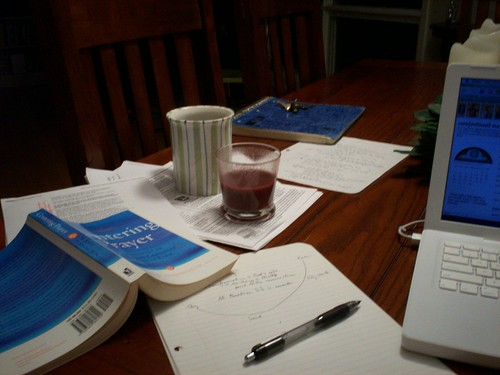
I am also asked from time to time how I prepare my sermons. I am very careful to whom I say it, but right now, I will make it public. Let me say, I agree with Piper 100%. I also let the adrenalin have a hold of me, and I do my sermon. For me, writing the sermon during the week, takes the whole passion away from the sermon. So, yes, Friday will be the day that I will start researching, but let me give you my steps:
 |
- 1. I print the passage, and read it, read it, read it. If it is an epistle, I try to read the whole epistle. If it's a longer book, I try to read as many headings on the text as I can, so I can pick up those themes that have to do with my text. From then, I do a cross reference with the online bible and resource, http://www.biblegateway.com/ I make notes, and more notes. The aim at this stage is that I make the text a part of me, and I know what the text deals with.
- The next step is to see what the text in it's original. I majored in Greek, so I go to Great Treasures website. This websites has all the NT texts parsed, so that saves heaps of time. It has 3 levels, beginner, intermediate and advanced. I used intermediate and advanced. At this stage, I try to understand the text as it stands in its original language, what its grammer and structure tells me. I haven't found a similar page in Hebrew, and if you have one, please give us the website in the comments below. Two indispensable resources to deal with the original languages are The New Linguistic and Exegetical Key to the Greek New Testament, andA Greek-English Lexicon of the New Testament and Other Early Christian Literature, 3rd Edition. For the New Testament, these two are a must at this stage of my sermon preparation.
- At this stage, after I have the text well into my head, I then go into trying to see what my people needs to hear. I think that if I do this before I go into the commentaries to understand the background of the text, it makes the background of the text to serve the hearers in their everyday life, and not just imparting interesting information about the background of the text, but that is not in any way useful in their everyday life. At this stage, I am looking for the main idea to come out of the text, not me bringing the main idea into the text. I love expository preaching, but I find it sometimes so dry, that people walk away with lots of information, but with no practical knowledge. I know that the greatest thing that has happened in history is the death and resurrection of Jesus, and that's where our future salvation lies. But I don't think we should wait till then to apply that miracle to our lives (the resurrection), but we can reap the benefits here and now. I am not talking about the feel good "gospel" of Joel Osteen or Joyce Meyer, but people like these have tapped into the practical side of the gospel, while Mike Horton and the like stop with the good news being only the salvation of the soul, which is the central message, but can't bring themselves to make the gospel an everyday event. I think that the right tone is between these two positions, although I must confess, I feel at home with the Horton's position, although I am aware of the drawbacks with such a position. So, in my sermon, the Cross is the centre, but I also point out how that sacrifice works out in our lives.
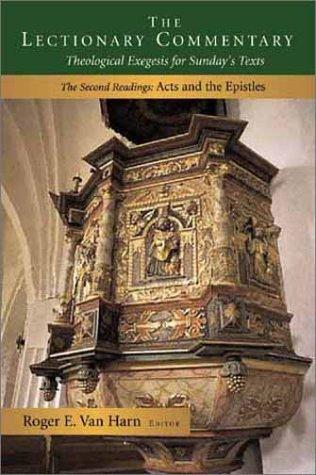
- This is when I go to the commentaries, to see if my ideas are wrong, or to confirm my ideas about the text, and to add also more "meat" to the bones of the sermon. At this stage, I try to set the background of the text for the hearers, and to check my assumptions with other Christians whom I consider wiser and more knowledgable than me. The message has also to be historical, meaning, that the Gospel is a historical message. and it is good to keep in tune with other christians who have wrestled with the text in other contexts, and in other eras. One of the resources that help me to deal with the text from a theological point of view are the volumes from The Lectionary Commentary: Theological Exegesis for Sunday's Texts, which deals with from all the readings found in the Lectionary. Yes, I am a lectionary man, I confess it. But then again, I feel compel to do it, because it creates a discipline for me, that I preach all that I need to preach, not what I want to preach, and keeps me in hand with historical Christianity.
- I do all of this on Friday and Saturday, and I go to sleep very early on Saturday. I wake up on Sunday very early, and put it together. Some would criticise that I haven't given myself enough time to put the sermon together, but I have found that if I do the sermon that way, I get much more out of it. Like Piper says, it works for him, it's not going to work for everybody. I really dislike the other preachers telling me that I should have the sermon done by the Friday. When I used to do that, I lost all passion to preach the manuscript by Sunday. It felt for me like I was reading non-sense, since I had no passion for it. It was something that I had done so long ago in my timeline, that it had lost its grip on me. Again, that's how it worked for me, it may not work with others like that. The problem is when you want to impose upon others what works for you, and make it like the only way to do sermons, and put down those who do it differently. God works differently with people, and we must let God do his work in people who are entrusted to share His word from the pulpit. At this stage, I finally bring all together into one sermon. I do it at least 4 hours before the sermon is actually delivered. I let all the I have read and studied "stew" during the Saturday night, and write it down on the Sunday morning, usually from 6 to 8 am, and then I preach it around 10:30 am, and it's fresh in my head. Notice, I didn't mentioned prayer. Why? It is during my personal devotions that I pray for enlightenment. I have seen many preachers pray just for the Sunday sermon to come out good. I pray for that as well, but I keep in mind that if God used an ass to give his message, I am equipped by Him to do the same. I rather, trust in the Lord that He will inspire me. The book that has helped me the most to put my sermon together has been The Homiletical Plot, Expanded Edition: The Sermon as Narrative Art Form. My previous pastor disliked the book, since even the author acknowledges that preaching in that form is rather a gift, not something learned. Jesus used stories, not points and subpoints for his message. Let's go back to preach the Jesus' way!!!!
- This is a new step in my sermon preparation, and one that many of my Reformed and Lutheran friends abhor. I put a keynote together in order to give a visual appeal to my sermon. People today need to see something to link it in their minds with what it's being said. Jesus' teachings in the temple reminds me of this. When he said in John 8:12 that he is the light of the world, he is referring to the four Menorahs placed at the four sides of the temple, which represented the light of the world. This is one of many visual examples that Jesus gave during his ministry, but the prophets were sometimes even dramatic in the way they conducted themselves, Hosea having a prostitute as a wife, or Ezekiel's wife dying in Ezekiel 24. Today, we have lost such an appeal, except for those tele-evangelist, who again the Hortons of the world criticise so much. People like Horton don't see the need to do such things, because they are following Paul's way of doing things, instead of Jesus. Imagine Horton and the like criticising Jesus by making some mud with his spit and place it into somebody's eyes, or Agabus taking Paul's belt and putting it around him to give his message (Acts 21:10-11)!!!! Yes, Paul says that people will come to faith by the preaching of the word, but the word incarnate did things himself while preaching that same word. Paul also did miracles, and the issue he was tackling was against those who took the melo-dramatic too far, not curtailing all melo-dramatic or visual aides. We are human after all, and the Hortons of the world put Jesus methods down without intent for sure, but they would consider Jesus' preaching and teaching methods, along with the prophets, of no use today. Tele-evangelist are what Paul is attacking, those who only emphasise the melo-dramatic, but don't preach the core of the Gospel. It's very difficult to keep both, as it is very difficult to conceive that Jesus is both mand and God. This final stage (although I pick up the pictures along my sermon preparations) gives me the visual aides in order to convey my message better to those hearing me. It helps me personally since it keeps me on track, and does not allow me to go down my own rabbit holes, since I have to stick talking of what's on the screen. I have to admit something here as well, where did I learn to do this? Steve Jobs, who was the master of this. The one mistake that preachers do when using the projector, is that they feel it with words. People are listening to words already, and what they want, is to see how these words look like. When I read that Jobs had a similar view, I just embraced the projector.


Well, after giving you my methods of preaching, I leave you once again, with Piper, and his way of putting the sermon together.

