Friday, January 13, 2012

Monday, October 31, 2011
The Christian Debate Over Halloween

Jim Roope
Tuesday, October 18, 2011
PCUSA on the wrong side of God's history

One example of this is how the PCUSA has turned from biblical teaching about sexuality, to a conforming stand with the culture that surrounds it.
MILWAUKEE — A Wisconsin man who left his Presbyterian ministry in California more than 20 years ago after telling his congregation that he is gay was welcomed back into the church leadership on Saturday as its first openly gay ordained minister.
In a quavering voice ripe with emotion, 56-year-old Scott Anderson told the hundreds of friends and backers who packed Covenant Presbyterian Church in Madison for his ordination ceremony that he never thought the day would come.
At least I can see that he was truthful at the beginning, resigning after he came out of the closet.
But what is worst for me, is to see how those who claim to be christians, can be so energetic at celebrating sin, yet, so "modest" in their worship to God.
When he was presented to the crowd, audience members gave him a thunderous standing ovation and began roaring with cheers.“That was very atypical of Presbyterians,” Doug Poland, an elder at Covenant Presbyterian Church, told the Wisconsin State Journal. “Usually our hands are in our laps.”
Unbelievable. These people not only give sin an standing ovation, but roar and cheer for what God clearly stands against. These people are not Christians, but pagans who call themselves christians.
But to really show how culture changes "christian"people, and commit to culture rather than to Scripture, the piece gives us an example of someone who was biblical, but was turned due to some of his friends being gay.
Anderson chose the Rev. Mark Achtemeier of Dubuque, Iowa, to deliver the sermon Saturday. Achtemeier used to be one of the most vocal opponents of gay ordination, but he announced a complete turnaround after friendships with gay Christians prompted him to re-evaluate scriptural teachings about homosexuality.
Let me ask this man, if he remembers what Deuteronomy says about being enticed by others to do what God has not commanded:
Deuteronomy 13:6-9
New International Version (NIV)
6 If your very own brother, or your son or daughter, or the wife you love, or your closest friend secretly entices you, saying, “Let us go and worship other gods” (gods that neither you nor your ancestors have known, 7 gods of the peoples around you, whether near or far, from one end of the land to the other), 8 do not yield to them or listen to them. Show them no pity. Do not spare them or shield them. 9 You must certainly put them to death. Your hand must be the first in putting them to death, and then the hands of all the people.
Of course, we don't kill people under the New Covenant, but the principle remains, one must not be swayed by anyone to go against the revelation of the Lord.
So, keep changing your mind just to supposedly affirm others. This is not showing God's love, rather, showing contempt for people's eternal destiny.
PCUSA may be right on the side of human history, but not in God's history.
Luis A. Jovel
Friday, September 16, 2011
Europe is not only becoming unchristian, but is going pagan
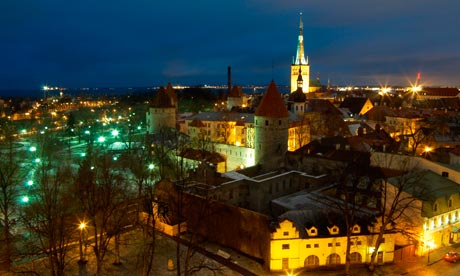
What happens to a nation when they forsake God? They turn to any other type of belief, of course. Estonia and the Czech are prime examples of this trend, but are not alone in this. There are many countries that are going that guy. Australia is an example of it, even though we may have mega churches like Hill Song, that gives a false impression that the gospel is well and vibrant here. Talking to a Pentecostal pastor today, I was told that once you leave the centres of the cities, Pentecostal churches struggle to survive.
Estonia's capital Tallinn. A 2005 poll found that only 16% of Estonians believed in God. Photograph: Ilja Dubovskis/AlamyEstonia and the Czech Republic are the two nations that often claim to be the least religious in Europe. And they seem to be proud of their unbelief. According to the census of 2000, 29% of the total population considered themselves as adherents of some religion. Almost 14% of them were Lutherans (in the 1930s the percentage of Lutherans was over 80), and about 13% Orthodox Christians divided between two churches: one under the canonical jurisdiction of ecumenical patriarchate and the other under the jurisdiction of Moscow patriarchate.
A Eurobarometer poll in 2005 found that only 16% of the Estonian population believed in God. With this number, Estonia hit the bottom of the list. However, at the same time more than half the population (54%) believed in some sort of spirit or life force. Thus it could be claimed that 70% of the Estonian population are believers, at least in some sense of the word. Professor Grace Davie's description of the British religiosity as"believing without belonging" seems to fit to the Estonian context as well.
The churches are on Sundays mostly empty and the ignorance of religion is widespread. According to the available statistics and surveys, the membership of religious associations in Estonia remains under one fifth of the total population.
Non-Estonians (mainly immigrants of Russian stock) are considerably more religious, and this becomes even more evident among the younger generations. Surveys show that young Estonians in general have become estranged from every form of religion that could be considered as traditional or as religion at all.
For this situation there are several reasons, starting from the distant past (the close connection of the churches with the Swedish or German ruling classes) up to the Soviet-period atheist policy when the chain of religious traditions was broken in most families.
In Estonia religion has never played an important role on the political or ideological battlefield. The institutional religious life was dominated by foreigners until the early 20th century. The tendencies that prevailed in the late 1930s for closer relations between the state and Lutheran church were ended with the Soviet occupation in 1940. While the Roman Catholic church maintained its dissident role in the Soviet countries, the Lutheran church was not successful in this. This might to have to do something with the Lutheran tradition in general as the role of the Lutheran church also in East Germany diminished considerably during the GDR days.
Although there were some clergymen associated with the dissident movement, the churches remained within the limits set for them by the Soviet authorities. The national reawakening in the late 1980s was accompanied with the religious revival. Religion was something that was seen as a connection with the pre-Soviet golden days. However, by the early 1990s the interest in institutionalised religion started to diminish. Currently the Lutheran church, still considered as the most traditional religious institution in Estonia, has fewer members than it had in the first half of the 1980s when the dues-paying membership reached its Soviet nadir.
The big question for the next decades concerning the religious situation in Estonia is what is going to be the future of the Lutheran church? Although it has been the dominant church among Estonians since the Reformation, the vast majority of younger generations have been estranged from it and the membership numbers are declining.
A new phenomenon during the last 15 years has been the rising number of Estonians identifying themselves with a nature-spirituality that could be defined as the Estonian neo-paganism. However, exactly what this is is much more difficult to explain, as it stresses individualism in religious matters. Although the organisation of the neo-pagans claim to represent pre-Christian religious tradition that has been passed from generation to generation through centuries, and dislikes the term neo-pagan, the historical facts do not support its arguments.
Estonian neo-paganism is closely associated with reverence to nature as well as reviving and following the centuries-old folk traditions, such as the lighting of bonfires during the summer solstice.
Reverence for nature and vocal protection of historical sacred groves has given a positive image to the movement and to their religion, known also as the Earth religion. On the other hand, there are not many neo-pagans officially affiliated with the organisation itself, and during the ancient holy days the groves are not filled with people. The claims by the organisation that all of that 54% who said they believed in spirit or life force are followers of old Estonian religious traditions is pure wishful thinking.