
Showing posts with label Republicans. Show all posts
Showing posts with label Republicans. Show all posts
Saturday, April 7, 2012

Monday, February 20, 2012
Which States in the USA get the most from the Federal Government?

So my Republican friends who are always having a go at how Democrats are wasting tax payers' money, well, they are wasting their money then Republican held states. We have now proof!
It's no secret: The federal budget is expanding faster than tax revenues, a trend that's been fueled by the rapid growth of entitlement programs and exacerbated by the recession. As a recent New York Times article documents, even as fiscally conservative lawmakers complain about deficit spending, their constituents don't want to give up the Social Security checks, Medicare benefits, and earned income tax credits that provide a safety net for the struggling middle class.This gap between political perception and fiscal reality is also reflected in the distribution of tax dollars at the state level: Most politically "red" states are financially in the red when it comes to how much money they receive from Washington compared with what their residents pay in taxes.Go into the link provided, and you can see the brake down of who gets what.
So much for those, so called, fiscal conservatives.
Hypocrisy at its best!!
P.D. Don't go crying that this is supposed to be "religious" blog. This blog was created to see ALL things from a Christian view point.
Wednesday, October 26, 2011
Pat Robertson Attacks Extremism by Republican Candidates

Pat Robertson, who recently made headlines for saying that if your spouse has Alzheimer's you are free to divorce them, has come back with a harsh critique of the way some Republicans, and some in the Tea Party, are going about in their politics.
Apparently, even Pat Robertson, an extremist himself, is afraid of the extremism found in the Republican Party. This is what he says about this issue:
“Those people in the Republican primary have got to lay off of this stuff. They’re forcing their leaders, the frontrunners, into positions that will mean they lose the general election.”As an example of the extremism found in the Tea Party, the article points at some practices by them.
Robertson is right about that, at least. Just ask Barry Goldwater. Tea Party denizens today are very fond of carrying signs at their rallies that quote Barry Goldwater’s famous phrase from his 1964 speechaccepting the Republican presidential nomination: “I would remind you that extremism in the defense of liberty is no vice.”
They should also be reminded that Barry Goldwater lost that election.
I am very worry for the USA. Obama is not looking good, but when I see the Republicans, they are a threat as well. Democracy is based on free choices, but in the USA, they only have two. Not much democracy if you tell me.
Well, at least, is good to see that some of the most extremist people can see that their own people will not be able to win the election, if they carry on the way they are going.
Tuesday, October 11, 2011
Who is really on the side of People
Not the Democrats for sure. The idea of a third party is almost anathema for some Americans, but hey, it's freedom to vote for a party that is not one of the main two.


Friday, September 16, 2011
Europe is not only becoming unchristian, but is going pagan
What happens to a nation when they forsake God? They turn to any other type of belief, of course. Estonia and the Czech are prime examples of this trend, but are not alone in this. There are many countries that are going that guy. Australia is an example of it, even though we may have mega churches like Hill Song, that gives a false impression that the gospel is well and vibrant here. Talking to a Pentecostal pastor today, I was told that once you leave the centres of the cities, Pentecostal churches struggle to survive.
Another thing that worries me, is that those countries that embraced the Protestant Reformation, are also as enthusiastic to disowned it. Take this as an example. In a documentary about the Christian Church on the History Channel presented by Diarmaid McCulloch "A History of Christianity", when the female pastor of Geneve is asked what she thinks about how John Calvin would feel to know that a woman pastor is the one heading his congregation, her answer was "well, that was his time, now this is my time".
Now Geneva is far from the propaganda that John Knox spread during his time, that Calvin's Geneva was "the most perfect school of Christ". The reality is that it never was the most perfect school of Christ. Even when Jesus was with his disciples, and believe me, that was the most perfect school led by the real founder of our faith, they had issues among them. The sad thing of it all, is that Lutheran and Reformed countries never achieved the Reformation they sought, and due to the laziness imbedded in their own traditions-no works, even though after you are saved although you are called to do them but be careful not to over do them just in case you believe that you are doing works to be saved, therefore, don't do anything- has paid out at the end.
Well, you can read the news article, and be informed.
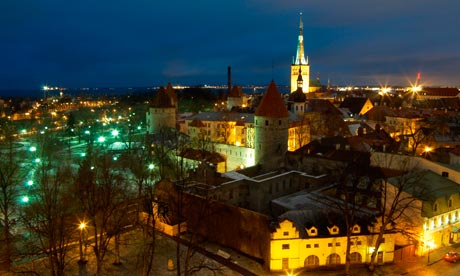
Estonia's capital Tallinn. A 2005 poll found that only 16% of Estonians believed in God. Photograph: Ilja Dubovskis/AlamyEstonia and the Czech Republic are the two nations that often claim to be the least religious in Europe. And they seem to be proud of their unbelief. According to the census of 2000, 29% of the total population considered themselves as adherents of some religion. Almost 14% of them were Lutherans (in the 1930s the percentage of Lutherans was over 80), and about 13% Orthodox Christians divided between two churches: one under the canonical jurisdiction of ecumenical patriarchate and the other under the jurisdiction of Moscow patriarchate.
A Eurobarometer poll in 2005 found that only 16% of the Estonian population believed in God. With this number, Estonia hit the bottom of the list. However, at the same time more than half the population (54%) believed in some sort of spirit or life force. Thus it could be claimed that 70% of the Estonian population are believers, at least in some sense of the word. Professor Grace Davie's description of the British religiosity as"believing without belonging" seems to fit to the Estonian context as well.
The churches are on Sundays mostly empty and the ignorance of religion is widespread. According to the available statistics and surveys, the membership of religious associations in Estonia remains under one fifth of the total population.
Non-Estonians (mainly immigrants of Russian stock) are considerably more religious, and this becomes even more evident among the younger generations. Surveys show that young Estonians in general have become estranged from every form of religion that could be considered as traditional or as religion at all.
For this situation there are several reasons, starting from the distant past (the close connection of the churches with the Swedish or German ruling classes) up to the Soviet-period atheist policy when the chain of religious traditions was broken in most families.
In Estonia religion has never played an important role on the political or ideological battlefield. The institutional religious life was dominated by foreigners until the early 20th century. The tendencies that prevailed in the late 1930s for closer relations between the state and Lutheran church were ended with the Soviet occupation in 1940. While the Roman Catholic church maintained its dissident role in the Soviet countries, the Lutheran church was not successful in this. This might to have to do something with the Lutheran tradition in general as the role of the Lutheran church also in East Germany diminished considerably during the GDR days.
Although there were some clergymen associated with the dissident movement, the churches remained within the limits set for them by the Soviet authorities. The national reawakening in the late 1980s was accompanied with the religious revival. Religion was something that was seen as a connection with the pre-Soviet golden days. However, by the early 1990s the interest in institutionalised religion started to diminish. Currently the Lutheran church, still considered as the most traditional religious institution in Estonia, has fewer members than it had in the first half of the 1980s when the dues-paying membership reached its Soviet nadir.
The big question for the next decades concerning the religious situation in Estonia is what is going to be the future of the Lutheran church? Although it has been the dominant church among Estonians since the Reformation, the vast majority of younger generations have been estranged from it and the membership numbers are declining.
A new phenomenon during the last 15 years has been the rising number of Estonians identifying themselves with a nature-spirituality that could be defined as the Estonian neo-paganism. However, exactly what this is is much more difficult to explain, as it stresses individualism in religious matters. Although the organisation of the neo-pagans claim to represent pre-Christian religious tradition that has been passed from generation to generation through centuries, and dislikes the term neo-pagan, the historical facts do not support its arguments.
Estonian neo-paganism is closely associated with reverence to nature as well as reviving and following the centuries-old folk traditions, such as the lighting of bonfires during the summer solstice.
Reverence for nature and vocal protection of historical sacred groves has given a positive image to the movement and to their religion, known also as the Earth religion. On the other hand, there are not many neo-pagans officially affiliated with the organisation itself, and during the ancient holy days the groves are not filled with people. The claims by the organisation that all of that 54% who said they believed in spirit or life force are followers of old Estonian religious traditions is pure wishful thinking.
Sunday, June 17, 2007
¡Here Come 'Los Evangélicos'!
June 6, 2007
by Luis Lugo, Director, and Allison Pond, Research Assistant

The Rev. Danny Cortés, senior vice president of Esperanza USA, greets President Bush at the National Hispanic Prayer Breakfast in 2005 (AP).
Next week hundreds of evangelical Latino pastors and church leaders will descend on Washington, D.C., for the annual National Hispanic Prayer Breakfast. Over the years, the event has steadily grown from a simple banquet to a three-day affair, running Wednesday through Friday. It includes not only the prayer breakfast but also lobbying visits to Capitol Hill, a women's leadership dinner focusing on health issues and the release of a major study on housing issues facing the Hispanic community.
As in the past, the event will attract high-level political leaders from both parties, including President Bush, who spoke at the first annual prayer breakfast in 2002 and has appeared every year since. An array of presidential candidates, including Hillary Clinton, Rudolph Giuliani, John McCain, Barack Obama and Bill Richardson also have been invited to speak at this year's event.
The prayer breakfast offers a vivid illustration of the growing presence and increasing political influence of Latino evangelicals, who now make up some 15% of the rapidly expanding Hispanic population in the U.S., according to a recent survey by the Pew Forum on Religion & Public Life and the Pew Hispanic Center. That survey also shows that among eligible Latino voters, evangelicals are twice as likely as Latino Catholics to identify with the Republican Party (37% vs. 17%). Latino evangelicals also are far more likely than Latino Catholics to describe themselves as conservative (46% vs. 31%).
In short, if Republicans have a prayer in making deep inroads into the Hispanic community, evangelicals may well provide their most direct route.
Religious Profile
As mentioned, nearly one-in-six U.S. Hispanics (15%) identify themselves as evangelicals, making them the second largest religious group in the Latino community. Other Protestants, including mainline Protestants (5%) and members of other groups such as Jehovah's Witnesses, account for another 8%. Most Hispanics (68%) are Roman Catholics, while seculars account for 8% of the total. Members of other faiths barely make up 1% of the Latino community.
The recently released Pew survey found that roughly half (51%) of Latino evangelicals are converts, mostly from Catholicism, and that more than two thirds (69%) identify with pentecostal and charismatic forms of Christianity. Although most (55%) Hispanic evangelicals are first-generation Americans, that percentage is lower than it is for Latino Catholics, more than two-thirds (68%) of whom are foreign born. This trend is reflected in the fact that nearly two-thirds of Latino evangelicals (63%) say English is their primary language or that they are bilingual, compared with less than half (45%) of Latino Catholics. Evangelicals also have slightly higher levels of education and income than the Latino population as a whole.

Latinos, who now comprise about 6% of the overall evangelical Protestant population in the U.S., are similar in many ways to their white evangelical counterparts when it comes to religious beliefs and practices. This is clearly the case with respect to the strong importance they place on religion (85% say it is very important in their lives) as well as the high proportion who say they pray daily (87%). Perhaps reflecting the zeal of recent converts, Latino evangelicals are somewhat more likely to say they attend church weekly than white evangelicals (70% compared to 61%) and to view the Bible as the literal word of God (76% compared to 62%).
Religion and Public Life
Latino evangelicals clearly stand out from other Hispanics when it comes to politics, and not just for their more Republican and conservative orientation. Latino evangelicals also show little reluctance when it comes to mixing faith and politics. For instance, they are far more likely than Hispanics generally (62% vs. 38%) to say that religion is very important in influencing their political thinking; an additional 24% say it is somewhat important. Moreover, by a solid majority (65%) they believe that churches should express their views on social and political questions, and by nearly as large a number (60%) they say that there has been too little religious expression by political leaders.

Latino evangelicals also take more conservative positions on many social issues compared with Latino Catholics and even compared with other evangelicals. For example, an overwhelming majority (86%) oppose gay marriage, compared with 52% among Latino Catholics and 67% among white evangelicals. A large majority (77%) also say that abortion should be illegal, compared with 54% and 61%, respectively, for Latino Catholics and white evangelicals.
On foreign policy issues, too, Latino evangelicals track fairly closely with the conservatism of their white evangelical counterparts. For instance, although their support for the Iraq war is not as high as among white evangelicals (49% vs. 60%, at the time the survey was conducted), they are significantly more likely than Latinos as whole (31%) to say that the use of force in Iraq was the right choice. The similarity is even more pronounced when it comes to the issue of Israel and the Palestinians, where the sympathy of a solid majority of Latino evangelicals (62%) is clearly with Israel. That level of sympathy is much higher than among Hispanics generally (33%) and rivals the level of support among non-Hispanic evangelicals (59%).
But Latino evangelicals differ from white evangelicals, and more closely resemble Latino Catholics, on other policy issues. For instance, nearly half (47%) oppose the death penalty, compared with just 16% of white evangelicals. A similar, and more predictable, departure from white evangelical attitudes is evident on the issue of immigration. While only a minority (33%) of non-Hispanic evangelicals say that immigrants strengthen American customs and values, a solid majority (59%) of Latino evangelicals hold that view. (The comparable figure among Latino Catholics is even higher at 67%.)

Latino evangelicals, along with other Latinos, also hold generally liberal views on economic issues and are more likely to support government programs and sympathize with poor people than are white evangelicals. For example, a large majority of Latino evangelicals favor government-guaranteed health insurance (70% vs. 58% of white evangelicals), and 57% (vs. 42% of white evangelicals) say poor people have hard lives due to lack of government services. Fully 66% of Latino evangelicals say they would rather pay higher taxes for more government services. In sum, Latinos in general, including evangelicals, tend to be big government social conservatives.
Recent Voting Patterns
The strong Republican orientation of Latino evangelicals compared with other Latinos was clearly evident in the 2004 presidential election. In that race, according to an analysis of state exit polls conducted by the Pew Hispanic Center, President Bush received 40% of the overall Latino vote, up from 34% in 2000.
That same analysis shows that Latino Protestants, the great majority of whom are evangelicals, accounted almost entirely for this increase. (The percentage of the Hispanic Catholic vote remained unchanged at 33%.) And not only did Latino Protestants vote more heavily Republican in 2004, they also represented a higher percentage of the Latino electorate than in 2000 (32% vs. 25%).

National exit poll numbers from 2006 suggest that Hispanics, along with the electorate as a whole, shifted away from the Republicans, giving only 30% of their vote to GOP candidates in the U.S. House of Representatives races. An analysis by the Pew Hispanic Center of U.S. Senate and state gubernatorial races around the country reveal a similar split in partisan preference. This represents a 10-point swing away from Republicans compared with 2004 and a seven-point swing compared with the midterm elections of 2002.
But the results were not entirely bleak for the Republicans. As the Pew Hispanic Center report points out, some Republican candidates in states with sizable Hispanic electorates, such as California, Texas and Arizona, did much better than their party's showing at the national level, and, in fact, received a share of the Latino vote that was comparable to the portion of the vote Bush received in 2004.
Bush-Cheney '04 campaign manager Ken Mehlman called the Latino vote "the single most important number" that came out of the 2004 election. More recently, in a piece posted on The Politico, Mehlman stated: "The majority party in the 21st century will be the party that reaches out to Hispanics." If that truly is the case, then the growing Latino evangelical community will have a significant say in the future direction of American politics.
Friday, May 18, 2007
The death of Jerry Falwell and what kind of legacy he left
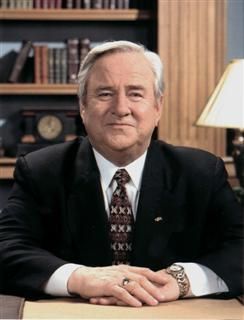 Jerry Falwell, died this week at the age of 73 has created many to write both and against what he has done during his life. Even one of my 'heroes' Albert Mohler has written about him. However, I find that he, as with others, have risen the guy above what others percieved of him, at least, within the Conservative Christian camp.
I would not say that Falwell was one of the greatest among us, but he tried, as do many of us. But the eulogies have been off the scale sometimes. To cite Mohler, he claims, ''The death of Dr. Jerry Falwell brings an end to one of the most fascinating lives of the twentieth century."
To say that of somebody who said that the attacks on 9/11 were the fault of those he saw as not being in par with God. This is what he said, "I really believe that the pagans, and the abortionists, and the feminists, and the gays and the lesbians who are actively trying to make that an alternative lifestyle, the ACLU, People For the American Way, all of them who have tried to secularize America. I point the finger in their face and say 'you helped this happen." Falwell also said that he needed gay and other who protested against his views to gain publicity, would not make him a person I would trust to head an organisation that represents Christianity in such a scale as Falwell did.
I have found an article on the The New Republic which, although does not praise Falwell as does Mohler, I think gives a good balance as the what sort of innovator Falwell really was. As the article says, he wasn't in the line of Martin Luther King Jr.
I post the article, which I find goes better to my way of viewing the legacy that Falwell has left behind, which differs greatly from Mohler's and I am sure, others. I thank God for Falwell, but Falwell will not be remembered as the likes of Martin Luther King Jr, or be held among the greatest among the American of the last century. Great, no doubt, but not among the giants. The legacy, must be embraced by all, not only by those who said yes to all you wanted. On with the arcle:
***********************************************************************************
Jerry Falwell's nasty contributions to American political life.
Farewell to Falwell
by Damon Linker Only at TNR Online Post date 05.17.07
Jerry Falwell's friends and allies on the right tell us that he was a force for democracy in America. This is true. Thanks to Falwell, millions of conservative evangelical and fundamentalist Protestants now actively participate in the political life of the nation, consistently mobilizing on the far-right side of the Republican Party. This makes Falwell historically important. But was he an admirable figure? Did he contribute to elevating the political culture of the United States? Have evangelical and fundamentalist Protestants proved to be thoughtful citizens, adding to the seriousness, depth, and rigor of public debate? Or have they, instead, injected superstition and sectarianism--in short, religiously based illiberalism--into the political life of the nation? More than six years into the failed evangelical-Protestant presidency of George W. Bush, the answer is obvious.
Defenders of the religious right like to link it to earlier examples of religious activism in American history--above all, abolitionism and the civil rights movement. Evangelicals supposedly follow in the footsteps of William Lloyd Garrison and Martin Luther King Jr. Yet the inconvenient fact is that Falwell and most of his fellow evangelicals sat out the civil rights movement. Back then, the segregationist Falwell thought that preachers were called to be "soul winners," not politicians.
What led Falwell join the political fray was not indignation at racial injustices but disgust at the sexual liberation of the 1960s and early 1970s. In the starkly Manichean outlook of Falwell and his followers, post-'60s America seemed to be (as he put it in his autobiography) a "war zone where forces of God do battle with forces of evil." For Falwell, it was the duty of all genuine Christians to take sides against Satan in this theological struggle.
At first, evangelicals hoped that one of their own--Jimmy Carter--was the right choice to lead the charge. But Carter quickly proved to be a disappointment. Few today remember that Falwell and other organizers of the Moral Majority were definitively persuaded to abandon Carter and embrace Ronald Reagan in 1980 because of a seemingly insignificant misjudgment on the part of the Carter administration. Under pressure from his fellow evangelicals to stem the tide of immorality in the nation, the president formed the White House Conference on the Family in 1979, hoping it would mollify his religious critics.
But, as with so many initiatives of the Carter administration, the plan backfired. In order to placate feminists and gay rights activists who feared that the executive branch would be holding up a single form of family life (the "traditional family") as legitimate and therefore denigrating "alternative lifestyles," the president quickly moved to pluralize the title of the conference (from "Family" to "Families")--an action that infuriated Falwell and his allies. It was only a matter of months before evangelicals withdrew their support from Carter and began actively campaigning against him. Reagan, they now believed, would be much more effective at combating the growing secularism and depravity of American life. The Moral Majority and its successor groups--Ralph Reed's Christian Coalition, James Dobson's Focus on the Family--have been fierce Republican Party loyalists ever since.
Approximately one-third of Americans describe themselves as evangelicals. Those millions of votes give them tremendous leverage with the GOP. In order to guarantee their continued support, the party has taken increasingly strident stands on the right flank of the culture wars, and never more so than under George W. Bush. The Bush White House has appointed right-wing justices to the Supreme Court. It has come out in support of a constitutional amendment banning gay marriage. It intervened in the right-to-die case of Terri Schiavo. It defends its foreign policy in quasi-theological terms. The president himself has even gone out of his way to portray himself as a born-again Christian whose decisions are guided by his personal relationship with the Lord. And as we've learned with the ongoing Justice Department scandal, Bush has packed his administration, at all levels, with conservative evangelicals--including numerous graduates from Falwell's fourth-rate Liberty University.
Those are Jerry Falwell's distinctive contributions to American political life. Falwell's death should serve as an occasion to reflect on the ambiguous goodness of all political ideals--very much including democracy.
Damon Linker is the former editor of First Things and author of The Theocons: Secular America Under Siege.
Subscribe to:
Posts (Atom)