Showing posts with label science. Show all posts
Showing posts with label science. Show all posts
Thursday, June 14, 2012

Saturday, April 7, 2012
Ten videos that will help you answer questions from skeptics

Myth 1: Contradictions in the Gospels
Myth 2: Pagan Parallels in the Mystery Religions
Myth 3: The Fraud Theory
Myth 4: Hallucinations
Myth 5: It's a Matter of Faith
Myth 6: Apparent Death Theory
Myth 7: It Was Merely Legend
Myth 8: Science Proves that Resurrections Cannot Occur
Myth 9: Not Enough Evidence
Myth 10: Lost Gospels
Monday, October 24, 2011
Ten wrong predictions of the end of the world and other events
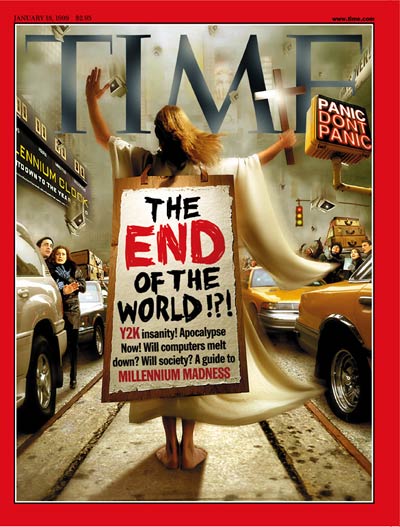
To me, this is more like a death wish, the end of the world. Why can't people just wish their own end, but have to include the rest of us, is beyond me.
Well, Time has published its Top 10 Failed Predictions. It would be a good idea for the rest of us to read them, and to see how people can get things wrong, and still be so unrepentant as Harold Camping.
But the predictions don't stop with the end of the world. There are plain flat denials about how the world works and is. Take for instance, The Flat Earth Society.
The last wrong predictions, number 10, is telling of how the Western historical narrative is so wrong. The the fall of Communism in Easter Europe and the Soviet Union, Francis Fukuyama thought that society and civilisation was in a path of evolution, being democracy and capitalism the pinacle of that evolution. The small article points two things out, that there's a great discontent in our liberal democratic countries, yet, undemocratic China is on the rise. The system that doesn't work for North Korea or Cuba, apparently works very well in China economically.
Well, interesting read. I commend you to read the ten worst predictions. Of musical interest, see prediction number 5, where the Beatles were dismissed as washed up before they hit it big.
Luis A. Jovel
Sunday, May 20, 2007
Talking to God gives body a boost

Communicating with God or other spirits can improve your physical health, Australian researchers suggest
A new report has reviewed controversial scientific evidence that religious or spiritual prayer can boost a believer's emotional and physical wellbeing.
The review, published in the Medical Journal of Australia, states that 74 per cent of Australians believe in a higher power, with many praying regularly as part of their worship.
The review, published in the Medical Journal of Australia, states that 74 per cent of Australians believe in a higher power, with many praying regularly as part of their worship.
"Some studies have shown a positive association between prayer and improved health outcomes," wrote lead author Marek Jantos, Director of the Behavioural Medicine Institute in Adelaide.
Mr Jantos, a clinical psychologist, said there were four ways prayer could have a positive effect on the body.
The first was through its "meditative" effects.
He said prayer was a Western form of transcendental meditation that worked in a similar way, slowing the breath and lowering the heart rate and blood pressure, thereby enhancing physiological wellbeing.
It also boosted positivity and improved mood, both of which had positive health-related spin-offs, Mr Jantos wrote.
Praying could also have a placebo effect on health.
For instance, in a study of heart patients, the half being prayed for by others made significantly better health improvements than those who were not prayed for.
But the most controversial benefit claimed by believers is through direct supernatural intervention from above.
Mr Jantos and co-author Professor Hosen Kiat, from the University of NSW, said the Bible offered several references to making a sick person well and Jesus himself was known for his personal practice of prayer and for his miraculous "super natural" healings.
The researchers warned that while this area was often dismissed as being beyond the reach of science, it should not be underestimated.
"Irrespective of whether scientists seek to attribute the benefits of prayer to the relaxation response, placebo or positive emotions, the most common reason people turn to prayer is their belief in a divine being that transcends the natural universe and hears and responds to prayer," the pair wrote.
They quote a chronically-ill elderly woman who believed God took her pain away every time she prayed.
Other researchers writing in the journal's special spirituality supplement call for more work to explore the link between religion and health and its relevance for Australian doctors and patients.
Friday, May 4, 2007
A blessing and a curse? Synthetic sperm and being human
 In the last post, I posted the news that scientist have finally dealt with the problem of sterility in men, by creating what it seems a proper way of self reproduction, and not taking into account third party options, such as donors, as for men to be able to father children.
I guess that this is good news for those couples, a man and a woman, who are unable to have children. This is a chance that they are getting so they can fulfill their dreams on becoming parents, when the affects of sin have not allowed them to fulfill their God given mandate, to multiply, Genesis 1:28 God blessed them and said to them, "Be fruitful and increase in number; fill the earth and subdue it. Rule over the fish of the sea and the birds of the air and over every living creature that moves on the ground."
However, as with other scientific advances, this discovery may be used for the wrong reasons. Among the first people that were glad to see such a discovery were lesbians couples. They now had a chance to raise a family which would be of their own, not having to bring a third person into their relationship in order to procreate.
I hope the law makers will make good judgments in order to maintain the integrity of the family, which apart from the children, are made up of a dad and a mom, and at best, when something unforseen has happen, of one father or one mother. The family has never been envisioned to be two dads or two moms, living under one roof together.
It is my hope, my prayer, that this discovery, as with stem cells research, will be treated with the care and wisdom needed as to not temper with the family structure that has served humanity for so long.
Luis A. Jovel
Wednesday, May 2, 2007
German scientists "manufacture" human sperm

24 April 2007
Hamburg (dpa) - A team of scientists in Germany have "manufactured" human sperm from bone marrow, raising the prospect of mass-producing sperm that can be used in IVF treatment or to restore fertility to men made sterile by cancer therapy.
Hamburg (dpa) - A team of scientists in Germany have "manufactured" human sperm from bone marrow, raising the prospect of mass-producing sperm that can be used in IVF treatment or to restore fertility to men made sterile by cancer therapy.
Such applications are still many years away. But scientists hope to grow fully formed sperm cells in as little as three years.
The research, conducted in Germany, has been published in the journal Reproduction: Gamete Biology.
The team led by Professor Karim Nayernia, from the University of Goettingen, first took bone marrow from male volunteers. From the samples, they isolated mesenchymal stem cells, which have previously been shown to grow into body tissues such as muscle.
Stem cells are immature cells that can be made to follow different functional pathways.
Using a form of vitamin A, the scientists coaxed the mesenchymal cells to become primordial germ cells (PGCs) - the first stage in the genesis of sperm. Specific genetic markers showed that some PGCs had further developed into more advanced spermatagonial stem cells.
Under normal circumstances, these cells eventually turn into mature, functional sperm that can fertilise an egg.
About 3 per cent of the original bone marrow stem cells were able to reach the point of being spermatagonial cells. In earlier work, Prof Nayernia derived sperm stem cells from mouse bone marrow and transplanted them into the animals' testes. Here they multiplied and began to differentiate further, without actually becoming fully formed sperm.
Nayernia said: "We are very excited about this discovery, particularly as our earlier work in mice suggests that we could develop the work even further.
"Our next goal is to see if we can get the spermatagonial stem cells to progress to mature sperm in the laboratory, and this should take around three to five years of experiments."
A priority will be to investigate why the cells fail to enter meiosis, the final stage of cell division before they become fully formed sperm.
One possibility is that they need to be accompanied by sertoli cells - special "nursing" cells found in the testes that have the job of nurturing growing sperm.
Producing sertoli cells from bone marrow, as well as sperm, is another avenue being explored.
Nayernia hopes in future the research will lead to new male infertility treatments. In particular he wants to look at the feasibility of restoring fertility to young men who have undergone chemotherapy for cancer.
This could involve culturing early-stage sperm cells in the laboratory from samples of bone marrow, or testes tissue. They would then be implanted back in the testes.
"We now have the first step, but the cells don't enter meiosis," said Nayernia. "If we could solve this problem, and I think it's scientifically possible, the next stage will be to produce functional sperm."
Subscribe to:
Posts (Atom)