Showing posts with label Egypt. Show all posts

Wednesday, December 14, 2011

Some Students don't know what the BIble is all about!!

Via Jim West.


Take this gem from a student paper (via P. Long on the twitter) -
“After killing a Hebrew slave, Moses fleas Egypt to live in the Sinai dessert.”
1- Moses didn’t kill a Hebrew slave, he killed an Egyptian.
2- He didn’t ‘fleas’ he ‘fled’.
3- The Sinai isn’t a ‘dessert’, it’s a desert.
4- Moses fled to Midian, the text says nothing about his fleeing to Sinai.
 
Such student blunders could easily be avoided if only they actually bothered to read the Bible (and spell). 
Ex 2:11 One day after Moses had become an adult, he went out among his people and he saw their forced labor. He saw an Egyptian beating a Hebrew, one of his own people. 12 He looked around to make sure no one else was there. Then he killed the Egyptian and hid him in the sand. 13 When Moses went out the next day, he saw two Hebrew men fighting with each other. Moses said to the one who had started the fight, “ Why are you abusing your fellow Hebrew? ” 14 He replied, “ Who made you a boss or judge over us? Are you planning to kill me like you killed the Egyptian? ” Then Moses was afraid when he realized: They obviously know what I did. 15 When Pharaoh heard about it, he tried to kill Moses. But Moses ran away from Pharaoh and settled down in the land of Midian.

Tuesday, November 1, 2011

Killed by wearing a Cross in Egypt. Here in Australia is a fashion!

I would like to comment on some abuses done against christians around the world. In this post, I will be pointing out the killing of a Christian in Egypt. His crime, wearing a crucifix. This is the result of the "Arab Spring". There's a movement now in the Middle East that has been attacking Christians for their faith. Liberation from dictators turned out to be the worst thing that could ever happened to Christians in the Middle East.

This news item is very revealing as to what the West has been supporting:

In mid-October Egyptian media published news of an altercation between Muslim and Christian students over a classroom seat at a school in Mallawi, Minya province.
The altercation lead to the murder of a Christian student. The media portrayed the incident as non-sectarian. However, Copts Without Borders, a Coptic news website, refuted this version and was first to report that the Christian student was murdered because he was wearing a crucifix."We wanted to believe the official version," said activist Mark Ebeid, "because the Coptic version was a catastrophe, as it would take persecution of Christians also to schools." He blamed the church in Mallawi for keeping quiet about the incident.
Today the parents of the 17-year-old Christian student Ayman Nabil Labib, broke their silence, confirming that their son was murdered on October 16, in "cold blood because he refused to take off his crucifix as ordered by his Muslim teacher." Nabil Labib, the father, said in a taped video interview with Copts United NGO, that his son had a cross tattooed on his wrist as per Coptic tradition, as well as another cross which he wore under his clothes.The altercation lead to the murder of a Christian student. The media portrayed the incident as non-sectarian. However, Copts Without Borders, a Coptic news website, refuted this version and was first to report that the Christian student was murdered because he was wearing a crucifix."We wanted to believe the official version," said activist Mark Ebeid, "because the Coptic version was a catastrophe, as it would take persecution of Christians also to schools." He blamed the church in Mallawi for keeping quiet about the incident.Today the parents of the 17-year-old Christian student Ayman Nabil Labib, broke their silence, confirming that their son was murdered on October 16, in "cold blood because he refused to take off his crucifix as ordered by his Muslim teacher." Nabil Labib, the father, said in a taped video interview with Copts United NGO, that his son had a cross tattooed on his wrist as per Coptic tradition, as well as another cross which he wore under his clothes.According to Ayman's father, eyewitnesses told him that his son was not beaten up in the school yard as per the official story, but in the classroom. "They beat my son so much in the classroom that he fled to the lavatory on the ground floor, but they followed him and continued their assault. When one of the supervisors took him to his room, Ayman was still breathing. The ambulance transported him from there dead, one hour later."

A teacher supported attack? Aren't teachers supposed to teach students to live in harmony? They wanted to cover up this incident as just a violent incident, but now we know better.

In the West, we are always told that schools are places of safety. Apparently in Egypt, if you are a Christian, this is not true.

What sort of ideology or religion drives a teacher to force a student to take off a crucifix, because he or she finds it offensive? And to top it all, invites other students to beat up the student to death for not following his or her directions?

If something like this would take place in a Western countries, Muslims countries would be up in arms, killing other Christians in their countries, and burning churches. An independent commentator wrote in an independent:
Prominent columnist Farida El-Shobashy wrote in independent newspaper Masry Youm "I was shaken to the bones when I read the news that a teacher forced a student to take off the crucifix he wore, and when the Christian student stood firm for his rights, the teacher quarreled with him, joined by some of the students; he was beastly assaulted until his last breath left him." She wondered if the situation was reversed and a Muslim was killed for not removing the Koran he wore, what would have been the reaction.
The reaction would have been what I just mentioned.

In my next article, we will see how Muslims come to Western countries, and demand that their rights be respected, but don't extend that courtesy to Christian foreigners in their land, and to their shame, not even to the Christian citizens that live in their country.

So the "Arab Spring", is becoming an "Arab Hell" for Christians. In my next entry, I will see this issue, now from an American point of view.

Luis A. Jovel 

Friday, July 10, 2009

SERVING GOD THROUGH OPPOSITION


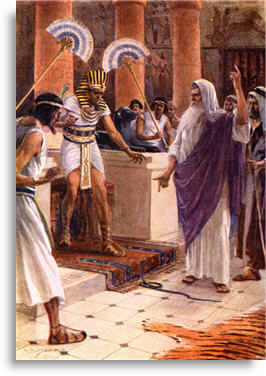
Exodus 5.

INTRO
Even when God sends us to do a task, there will always be opposition against us. This should not make us feel defeated, rather, as with Paul in II Cor. 13, we should see our setback as bringing out the glory of God even greater. When facing opposition, sometimes the last thing we think is that God has a plan, but as with Moses, and in the New Testament, Jesus, we should always trust in our Father’s greater plan.

Explanation Vss. 1-9: Moses passes the Lord’s message to Pharaoh, what the Lord requires of his people. He calls “the Lord” in the singular, since Egypt was a polytheistic society. This is the first of many demands, 5:1; 7:16; 8:1, 20; 9:1, 13; 10:3, etc. Knowing. Pharaoh didn’t know the Lord; this is the theme that is central to the book. Reminds us of what knowing means in the book of John, which is being saved.
Moses explains to Pharaoh how the Hebrews were to serve the Lord, with a festival. If this would not take place, they would be stricken by ‘pestilence or sword’, cf. vs. 21 where the sword is mentioned again, but the one using it is Pharaoh.
From vss. 6-9, Pharaoh’s words are repeated in vss. 17-18, and because they came from Pharaoh’s mouth, they are law.
Illustration: Moses lets the Pharaoh know the words of the Lord. Pharaoh’s response is to say that he didn’t know the Lord, and proclaims some words himself, adding to the work of the Israelites, and to call them lazy. Pharaoh calls what Moses says “deceptive words”, or literally “lies”. For Pharaoh, Moses and his God were fakes. So the issue comes down as to whose words are true, Pharaoh or the Lord’s.
What Moses was asking Pharaoh was not an impossible thing, since religious texts show that Egyptian workers took days off for religious festivals.
Application: Moses’ first encounter with Pharaoh’s did not go down well. His first attempt, he found opposition, and very stiff at that. We are also entrusted with the most important message to those who are under the control of the devil, the gospel. Our work becomes more difficult since we have very famous sceptics who put the word of God, the Bible, in doubt. We must press on, although the opposition may seem to be in control. What’s in our lives that we know that Lord has given us promises, and we may lose heart seeing the opposing facts in our lives?? Our faith should look beyond any opposition, and hold on to God’s word.

Explanation Vss. 10-18: The language used by the slave drivers to the Isralite supervisors is legal language. This point out the Pharaoh’s word is law. Bricks in Egypt were as large as 12 inches, 6 inches tall and 6 inches deep. The need for straw comes because it provided humic acid, which increased the effectiveness as binder. Stubble, this was dried out remains in the field after the harvest, which had no humic acid, therefore, less suitable for their work. As the slave drivers were oppressing the Isralite supervisors, they approach Pharaoh to plead their case. Pharaoh again accuses them of laziness, and does not take attention of their pleads.
Illustration: The foreman call themselves “servants”, Pharaoh’s response is for them to get back to ‘serve’, ‘work’, cf. vss. 15, 18. Here we see the Isralites crying to Pharaoh, cf. 15:8. The usual cry is to the Lord, cf. 2:23; 8:8; 14:10, 15; 15:25; 17:4; 22:22.
Application: This is an example to whom we should not go when in trouble. We cannot go to the one who has us in slavery for delivery. How many times have we considered going to those who are afflicting us, in order for them to change their ways. The world will not change, but we have someone to cry out, and it is the Lord. Just as the Isralites were given stubble to complete their task, the world would always give us something that will quickly pass away, that will wither sooner or later. The Lord offers us eternal life, no temporal pleasures. We should always keep our eyes on the author and perfecter of our faith, Jesus, Heb. 12:2.

Explanation Vss. 19-21-6:1: The supervisors turn their anger to Moses and Aaron. They forget that they are sent from the Lord, but quickly attribute the blame for their situation on them. Pharaoh’s sword is the object of their fear, not the Lord’s sword, cf. 3.
Illustration: the foremen are looking for a way out of their trouble, and they have genuine concern for the Isralite workers. They blame not Pharaoh’s reluctance to hear the word of the Lord, but they blame those who brought to him the word of the Lord, Moses and Aaron. Moses cries out to the Lord, and the Lord answers him, explaining to him as to why Pharaoh has acted that way.
Application: We have a tendency to blame others for our own situation. We are not that different from the Isralite foremen. Sometimes we come to church with the expectation to be told how good we are, how gentle, how Christian!! But there’s no one good here but Jesus, cf. Mat. 19:17; Mk. 10:18; Lk. 19:19. Don’t blame the preacher when he is exposing the word of God, and you feel and know that you are not living a Christian life. The word is preached in order to show you how the Lord can take away those things that make us all sinners, and therefore, don’t have a relationship with our Lord. But what if there is no sin, and you still face opposition in your life, work, family, club, church??? Don’t blame others will not fix the problem. Just as Moses cried out to the Lord, we are to do the same. Remember Jesus cried out to the Father when in need in the Garden of Gethsemane, and he got an answer, to go the cross. Moses had much to endure before seeing what God was to do with Pharaoh. We also have a lot to live before we can somehow comprehend God’s plan in our lives.

Conclusion: Life is full of hardship, trouble, and opposition. But as believers, we must trust that God has a greater plan for our lives than we can see from our perspective. God was working his plan through Israel’s suffering, which was the showing of his mighty hand in Egypt. What are you going through at this moment, that you feel there is no way out, that it doesn’t make sense or you don’t deserve it? Let’s remember that we have given our lives to the Lord, and he knows the outcome of our lives, even though we may not see the light at the end of the tunnel. Let us treasure what scripture tells us, “28And we know that in all things God works for the good of those who love him, who have been called according to his purpose.”