Showing posts with label Lutheran. Show all posts

Monday, August 6, 2012

Christianity must change or die, but not like Gene Robinson suggested

I've been told that the church must change in order to continue as a living organism. But the people who tell me that, usually belong to churches that are dying, exactly for implementing the changes they suggest to me.

Ross Douthat, has written a good piece dealing with this issue in the New York Times, where he deals with this issue. Liberals have been telling us for years that the church must change in order to stay alive, but the churches lead by liberals are the ones dying because of their misguided change.


Can Liberal Christianity Be Saved?IN 1998, John Shelby Spong, then the reliably controversial Episcopal bishop of Newark, published a book entitled “Why Christianity Must Change or Die.” Spong was a uniquely radical figure — during his career, he dismissed almost every element of traditional Christian faith as so much superstition — but most recent leaders of the Episcopal Church have shared his premise. Thus their church has spent the last several decades changing and then changing some more, from a sedate pillar of the WASP establishment into one of the most self-consciously progressive Christian bodies in the United States. 
As a result, today the Episcopal Church looks roughly how Roman Catholicism would look if Pope Benedict XVI suddenly adopted every reform ever urged on the Vatican by liberal pundits and theologians. It still has priests and bishops, altars and stained-glass windows. But it is flexible to the point of indifference on dogma, friendly to sexual liberation in almost every form, willing to blend Christianity with other faiths, and eager to downplay theology entirely in favor of secular political causes.

Spong was wrong then, and is wrong now. He wants to kill of Orthodox Christianity, so it doesn't stand in the way of his sinful life, but at the end, he seems to had inflicted a wound to his own type of christianity. The issue was then, and is now, that those who should have known better, did nothing, instead went on to dismantle the Episcopal Church in order to be in the good graces of today's society and culture.  So there's no interest in defending the truth of the Bible against a society that needs it so much, rather, picks up their political fights, which contradict the Gospel at its core.


Yet instead of attracting a younger, more open-minded demographic with these changes, the Episcopal Church’s dying has proceeded apace. Last week, while the church’s House of Bishops was approving a rite to bless same-sex unions, Episcopalian church attendance figures for 2000-10 circulated in the religion blogosphere. They showed something between a decline and a collapse: In the last decade, average Sunday attendance dropped 23 percent, and not a single Episcopal diocese in the country saw churchgoing increase.

Well, there's nothing they can offer but the same thrush that the young people are facing outside the church. We don't see a great increase in the audience they intended to target. In Australia, the Uniting Church, is experiencing something similar. Yet, the churches it was meant to replace, seem to either thrive (the Methodist), or at least survive (the Presbyterians).


This decline is the latest chapter in a story dating to the 1960s. The trends unleashed in that era — not only the sexual revolution, but also consumerism and materialism, multiculturalism and relativism — threw all of American Christianity into crisis, and ushered in decades of debate over how to keep the nation’s churches relevant and vital. 
Traditional believers, both Protestant and Catholic, have not necessarily thrived in this environment. The most successful Christian bodies have often been politically conservative but theologically shallow, preaching a gospel of health and wealth rather than the full New Testament message.
My sentiment as well. But I wouldn't call prosperity Gospel people "traditional believers". They are as far from the Gospel as the Mormons or Jehova Witnesses. They have a total different religion. These churches thrive, not because they are Gospel driven, rather, because they are money driven. People want money and wealth, so they go to these churches to get a hand of how to obtain it, or make it.

But if conservative Christianity has often been compromised, liberal Christianity has simply collapsed. Practically every denomination — Methodist, Lutheran, Presbyterian — that has tried to adapt itself to contemporary liberal values has seen an Episcopal-style plunge in church attendance. Within the Catholic Church, too, the most progressive-minded religious orders have often failed to generate the vocations necessary to sustain themselves.
Not all Methodist, Lutheran or Presbyterians are going the way of the dinosaurs, but those denominations that have adopted the Episcopal way, are going the way of the Episcopal church.

Both religious and secular liberals have been loath to recognize this crisis. Leaders of liberal churches have alternated between a Monty Python-esque “it’s just a flesh wound!” bravado and a weird self-righteousness about their looming extinction. (In a 2006 interview, the Episcopal Church’s presiding bishop explained that her communion’s members valued “the stewardship of the earth” too highly to reproduce themselves.) 
Liberal commentators, meanwhile, consistently hail these forms of Christianity as a model for the future without reckoning with their decline. Few of the outraged critiques of the Vatican’s investigation of progressive nuns mentioned the fact that Rome had intervened because otherwise the orders in question were likely to disappear in a generation. Fewer still noted the consequences of this eclipse: Because progressive Catholicism has failed to inspire a new generation of sisters, Catholic hospitals across the country are passing into the hands of more bottom-line-focused administrators, with inevitable consequences for how they serve the poor. 
 Liberals don't want to accept their peril. As we see in the case of Katherine Jefferts Schori, she wants to window dress their declining numbers by passing it as a way of "stewardship of the earth". This type of denial would not be allowed in other quarters. And in the case of "progressive" Catholicism, it just won't get people inside their orders. If some progressives nuns wants to affirm somebody's homosexuality, why would, they in turn, would quit being a lesbian in order to turn into a life of celibacy?


But if liberals need to come to terms with these failures, religious conservatives should not be smug about them. The defining idea of liberal Christianity — that faith should spur social reform as well as personal conversion — has been an immensely positive force in our national life. No one should wish for its extinction, or for a world where Christianity becomes the exclusive property of the political right.

May the Lord deliver us from the right to take the face of Christianity!!!!

What should be wished for, instead, is that liberal Christianity recovers a religious reason for its own existence. As the liberal Protestant scholar Gary Dorrien has pointed out, the Christianity that animated causes such as the Social Gospel and the civil rights movement was much more dogmatic than present-day liberal faith. Its leaders had a “deep grounding in Bible study, family devotions, personal prayer and worship.” They argued for progressive reform in the context of “a personal transcendent God ... the divinity of Christ, the need of personal redemption and the importance of Christian missions.” 
Today, by contrast, the leaders of the Episcopal Church and similar bodies often don’t seem to be offering anything you can’t already get from a purely secular liberalism. Which suggests that per haps they should pause, amid their frantic renovations, and consider not just what they would change about historic Christianity, but what they would defend and offer uncompromisingly to the world.Absent such a reconsideration, their fate is nearly certain: they will change, and change, and die.

I wonder then, how these "liberals" couldn't pass on their faith to the next generation. There's still much we have to learn. 

Friday, July 20, 2012

Let's laugh and learn with our Lutheran friends

I am not a Lutheran, or wish to be one. But I appreciate how some make the christian faith available, and well, this is one of those I watch to learn, and laugh.

Wednesday, October 19, 2011

For those of us interested in Reformation Studies, this series poses a good future resource:

Vandenhoeck & Ruprecht, projectpartner of Refo500, has started a series academic studies focussing on the religious, theological, political, social, legal, and cultural dimensions of the Reformation. In this series, monographs and thematic collections will be published in English, German and French. The series is characterised by an interdisciplinary approach, international cooperation, and a high scholarly level.
Vandenhoeck__Ruprecht.pngForthcoming volumes in 2012Vol. 1: Benjamin T.G. Mayes: Counsel and Conscience. Lutheran Casuistry and Moral Reasoning After the Reformation
Vol. 2: Andreas Beck (Ed.): Melanchthon und die Reformierte Tradition
Vol. 3: Peter Opitz (Ed.): The Myth of the Reformation
Vol. 4: Volker Leppin/Herman Selderhuis: Anti-Calvinismus und Krypto-Calvinismus im konfessionellen Zeitalter
Manuscript proposalsManuscript proposals can be sent to the general editor of the series.
Editorial boardMarianne Carbonnier (Paris)
Günter Frank (Bretten)
Bruce Gordon (New Haven)
Ute Lotz-Heumann (Tucson)
Mathijs Lamberigts (Leuven)
Barbara Mahlmann-Bauer (Bern)
Tarald Rasmussen(Oslo)
Johannes Schilling (Kiel)
Herman Selderhuis (general editor, Emden)
Günther Wassilowsky (Linz)
Siegrid Westphal (Osnabrück)

For more information, see the link.

Friday, September 16, 2011

Europe is not only becoming unchristian, but is going pagan


What happens to a nation when they forsake God? They turn to any other type of belief, of course. Estonia and the Czech are prime examples of this trend, but are not alone in this. There are many countries that are going that guy. Australia is an example of it, even though we may have mega churches like Hill Song, that gives a false impression that the gospel is well and vibrant here. Talking to a Pentecostal pastor today, I was told that once you leave the centres of the cities, Pentecostal churches struggle to survive.

Another thing that worries me, is that those countries that embraced the Protestant Reformation, are also as enthusiastic to disowned it. Take this as an example. In a documentary about the Christian Church on the History Channel presented by Diarmaid McCulloch "A History of Christianity", when the female pastor of Geneve is asked what she thinks about how John Calvin would feel to know that a woman pastor is the one heading his congregation, her answer was "well, that was his time, now this is my time".

Now Geneva is far from the propaganda that John Knox spread during his time, that Calvin's Geneva was "the most perfect school of Christ". The reality is that it never was the most perfect school of Christ. Even when Jesus was with his disciples, and believe me, that was the most perfect school led by the real founder of our faith, they had issues among them. The sad thing of it all, is that Lutheran and Reformed countries never achieved the Reformation they sought, and due to the laziness imbedded in their own traditions-no works, even though after you are saved although you are called to do them but be careful not to over do them just in case you believe that you are doing works to be saved, therefore, don't do anything- has paid out at the end.

Well, you can read the news article, and be informed.

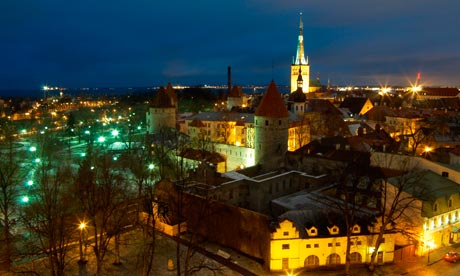
Estonia's capital Tallinn. A 2005 poll found that only 16% of Estonians believed in God. Photograph: Ilja Dubovskis/Alamy

Estonia and the Czech Republic are the two nations that often claim to be the least religious in Europe. And they seem to be proud of their unbelief. According to the census of 2000, 29% of the total population considered themselves as adherents of some religion. Almost 14% of them were Lutherans (in the 1930s the percentage of Lutherans was over 80), and about 13% Orthodox Christians divided between two churches: one under the canonical jurisdiction of ecumenical patriarchate and the other under the jurisdiction of Moscow patriarchate.

A Eurobarometer poll in 2005 found that only 16% of the Estonian population believed in God. With this number, Estonia hit the bottom of the list. However, at the same time more than half the population (54%) believed in some sort of spirit or life force. Thus it could be claimed that 70% of the Estonian population are believers, at least in some sense of the word. Professor Grace Davie's description of the British religiosity as"believing without belonging" seems to fit to the Estonian context as well.

The churches are on Sundays mostly empty and the ignorance of religion is widespread. According to the available statistics and surveys, the membership of religious associations in Estonia remains under one fifth of the total population.

Non-Estonians (mainly immigrants of Russian stock) are considerably more religious, and this becomes even more evident among the younger generations. Surveys show that young Estonians in general have become estranged from every form of religion that could be considered as traditional or as religion at all.

For this situation there are several reasons, starting from the distant past (the close connection of the churches with the Swedish or German ruling classes) up to the Soviet-period atheist policy when the chain of religious traditions was broken in most families.

In Estonia religion has never played an important role on the political or ideological battlefield. The institutional religious life was dominated by foreigners until the early 20th century. The tendencies that prevailed in the late 1930s for closer relations between the state and Lutheran church were ended with the Soviet occupation in 1940. While the Roman Catholic church maintained its dissident role in the Soviet countries, the Lutheran church was not successful in this. This might to have to do something with the Lutheran tradition in general as the role of the Lutheran church also in East Germany diminished considerably during the GDR days.

Although there were some clergymen associated with the dissident movement, the churches remained within the limits set for them by the Soviet authorities. The national reawakening in the late 1980s was accompanied with the religious revival. Religion was something that was seen as a connection with the pre-Soviet golden days. However, by the early 1990s the interest in institutionalised religion started to diminish. Currently the Lutheran church, still considered as the most traditional religious institution in Estonia, has fewer members than it had in the first half of the 1980s when the dues-paying membership reached its Soviet nadir.

The big question for the next decades concerning the religious situation in Estonia is what is going to be the future of the Lutheran church? Although it has been the dominant church among Estonians since the Reformation, the vast majority of younger generations have been estranged from it and the membership numbers are declining.

A new phenomenon during the last 15 years has been the rising number of Estonians identifying themselves with a nature-spirituality that could be defined as the Estonian neo-paganism. However, exactly what this is is much more difficult to explain, as it stresses individualism in religious matters. Although the organisation of the neo-pagans claim to represent pre-Christian religious tradition that has been passed from generation to generation through centuries, and dislikes the term neo-pagan, the historical facts do not support its arguments.

Estonian neo-paganism is closely associated with reverence to nature as well as reviving and following the centuries-old folk traditions, such as the lighting of bonfires during the summer solstice.

Reverence for nature and vocal protection of historical sacred groves has given a positive image to the movement and to their religion, known also as the Earth religion. On the other hand, there are not many neo-pagans officially affiliated with the organisation itself, and during the ancient holy days the groves are not filled with people. The claims by the organisation that all of that 54% who said they believed in spirit or life force are followers of old Estonian religious traditions is pure wishful thinking.


Wednesday, December 8, 2010

Never too late to say sorry


“Lutherans” to Anabaptists: Sorry
Wednesday, July 28, 2010, 10:37 AM
Anthony Sacramone
So, after 450-plus years, some Lutherans*, presumably trapped in an airport somewhere, bumped from their flights to see the La Brea Tar Pits, or unable to compete in their respective bowling leagues due to wrist-lock, have decided to kill time by issuing a formal apology to the descendants of the 16th-century Anabaptists, namely, Wanda and Earl Kolodny of Fort Wayne, Indiana.

Some perspective. To begin with, one must understand that, in nailing his theses to the Wittenberg church door, Martin Luther bore a hole large enough to let loose a bevy of self-proclaimed prophets, apostles, revolutionaries, screwballs, and unitarians. Some were calling for the violent overthrow of the existing order. Some were calling for the near-total withdrawal from the existing order. And some just wanted to prance around naked and sing an early version of the theme to Caddyshack.

Among this dappled crew were those who believed the church to be so corrupt that only the re-baptizing of professing adults could make a clean spiritual start of things. Infant baptism was mere thralldom to an ecclesiastical leviathan that had made common cause with corrupt civil government, pious hypocrites, and whoever invented the atomic wedgie.


Luther, never known to mince words, felt something to be amiss with these folks: “Who seeth not here in the Anabaptists, men not possessed with devils, but even devils themselves possessed with worse devils?” Luther being Luther, he encouraged their being tossed into rivers and beaten with sticks—oh, you know how he gets.

Among the radicals, however, was one relatively benign sort, a guy named Menno Simons, from whom modern-day Anabaptists take their name: the Simonizers. Harmless, pacificisististical, and really bad drivers, the Simonizers can be found buffing a Hyundai near you.

And here we are, in 2010, making amends. So, Mr. and Mrs. Kolodny, as a poor Lutheran layman, allow me to offer my deepest apologies for the 1500s and the rather intemperate recommendations of Dr. Luther.

I promise: it will never happen again.

* It should be noted that the Lutheran Church-Missouri Synod is not in league with the Lutheran World Federation, which issued the apology, but is in league with the Justice League of America. Which is to say, as far as I know, the LCMS does not apologize, but may still feel really bad about it all. Rumor has it that the new president of the LCMS has asked Congorilla to mediate a brunch in the not-too-distant future.

Wednesday, August 25, 2010

Our God Reigns The confession of the New Perspective on Paul??

Talking to my best friend, who is a Lutheran, we talked about how his Lutheran Church has the Book of Concord as a guide for a confession. Then, we talked how the Reformed have the Confessions, such as the Helvetic or Canons of Dort.

Then he asked me, what sort of document did I have as a guide.

I paused for a moment, and answered, "What St. Paul Really Said"!!!! We had a laugh, but N. T. Wright's little book is so well crafted that it may end up being a confession of faith. Just as the Confessions mentioned before were, and are still attacked by its opponents, this little book has suffered the same.

Nevertheless, chapter three of the book has really opened my mind as the real meaning of this song, so let us sing!!!!


Thursday, July 22, 2010

Iron in our blood. The Evangelical need to pick a fight


I have been reading a very interesting blog, in which I found the following paragraph:
the culture of conservative evangelicals (and especially of the conservatively reformed) is sickening to me. everything is about a battle for x’ or ‘defending the heart of the gospel’ (which changes as the opponent changes…one day it’s justification and n.t. wright is a heretic, the next day it’s inerrancy and kenton sparks is a heretic). that’s not what i want to do with my time. i didn’t go to seminary so that i could get a ‘heresy hunter’ license and claim my spot among machen’s warrior children. i went to seminary because i want to positively contribute to the way christians think about the bible, about their god, and about how to live their lives in relationship to that god.


One can easily get that from listening to the White Horse Inn or Issues Etc. Mind you, I listen to them every week, and in the case of the later, every day. Their shows are interesting, but you just wondered if they ever have a positive view of something that does not involve Calvin, Machen or Luther.

Take for example Issues Etc, if you don't read Scripture under the lenses of Law and Gospel, you are no better than a donkey reading the newspaper, you just won't understand it. But if you if apply the Lutheran Method, then your eyes will be open and then you will understand the message. This sounds to me more like the Jehovah Witness claim about need to read the books written by Russel in order to understand Scripture. I guess both never heard about the guidance of the Holy Spirit!!!

In the case of the New Reformed, if you say that that Reformers' claim that Justification by faith is not the center of the gospel, you may as well reject being a christian. Jesus' proclamation was not that all were saved by justification by faith, which of course, was a central theme that was developed by Paul, but his initial and final instructions were the following:
Mark 1:14.."The kingdom of God is near. Repent and believe the good news!"


and:

Mark 16:15...He said to them, "Go into all the world and preach the good news to all creation.


It looks like Jesus is very consistant about what the gospel was all about, was about the kingdom. Later, and rightly, the other historical aspects were added, cf. I Cor. 15:3-7.

But what I like about the article, is that the author rightly points out that the "heart" of the gospels changes so much, from every "defender" of it, that it looks more like the gospel is an octopus, with many hearts. The octopus has 3, but my neo Reformed friends, and other conservatives, are starting to look like the Roman Catholics at the time of the Reformation, having many of Peter's heads, as well as more bones from the apostles than the apostles themselves had!!!!!!

Sounds like we got rid of some relics, to pick up another ones, more acceptable to their liking. Once the common enemy of the time, the Catholics, were "vanquished", the Protestants turned, and still turned against each other to say to the other that they were wrong. The Reformers would be turning in their graves if they would know what sort of legacy would follow their bible loving, Scripture upholding and true christian followers.

Looks like we have a long way to go in order to reach unity in the body of Christ.

Luis A. Jovel

Friday, May 29, 2009

The Development of Worship within Christianity


INTRODUCTION
Worship has always been a part of the people of God. After the fall, we are told that “people began to invoke the name of the Lord”, cf. Genesis 4:26. This, as Evelyn Underhill has commented, may be the “acknowledgment of Transcendence” . We can see that from the beginning of human kind, there has been a need to acknowledge that that is beyond us. But the definition of worship is not as straight forward as what’s being said. Underhill tells us that worship “is the response of the creature to the Eternal. Geoffrey Wainwright takes a similar view, calling worship a “faithful human response to the revelation of God’s being, character, beneficence and will. The two previous authors have focused on the response of the worshipper, from a Catholic perspective, Patrick Bishop says that worship “consists in a response of veneration in the face of the recognized presence of God”, bringing God into the act of worship along with the worshipper.

Historical Aspects of Worship
As it has been mentioned before, as described by Scripture, worship has been an integral part of humanity’s response to God’s actions around us. Christian worship in particular, borrowed from the worship liturgy found in Second Temple Judaism. Prayer was included in worship as well as the reading and exposition of a biblical passage. The two main innovations introduced by the Christians were that the main day of worship was no longer on the Sabbath, but on Sunday, and that Jesus became the focus of worship. Justin Martyr (100-165) tells us that the Gospels and the writings of the prophets were read aloud during the Christian service, cf. First Apology 67. Worship became a very integral issue in the development of Christology, since Christians saw the worship of Jesus as an integral part of their worship. If Jesus were only a creature, Christians would easily be called idolaters. The church went through great pains in order to formalise her teachings about who the person of Jesus was, and the councils of Nicea and Constantinople served to settle the dispute and affirm that Father, Son and Holy Spirit were equally deserving of our worship, since the three are equally God. It was around this period, that the worship of the Church changed greatly, since there was no need to hide from fear of persecution, and Christianity, being the official religion of the empire, took over the pagan temples. As the early type of worship had been simple in its form, it was during this time and afterwards, that ceremony took central stage in the worship practice of the church. The two stages of the Mass, the Liturgy of the Word and the Liturgy of the Upper Room, gave way to more elaborate forms of worship. This gradually grew to such an extent that the priest was the only one doing something in the worship service, while the attendants were mere spectators. It must be mentioned that it was during this period, that the Eastern and Western parts of the church took different approaches to worship, the former taking a more mystical approach, while the later, a more rational.

By the time of the Reformation, the Reformers had a reaction to the lack of input from the congregation to the worship service. The response to the manner of worship was threefold, representing the three major trends of the time. The Roman Catholics retained the usage of musicians but with minimal congregational input; the Calvinists, abolished music all together and opted for congregational singing; and the Lutherans, was a combination of the two. For most of the Protestants, the exposition of the word became the highest reason of corporate worship. These developments from the Reformation period are more or less still present in the congregations of both Roman Catholic and Protestant persuasions, with some variations.

The Usefulness of Worship
Worship has an impact on the worshipper that goes beyond the liturgical service. As Patrick Bishop tells us, worship “imposes an ethic upon us”. Romans 12:1-2, tells us to offer ourselves in a spiritual worship, and also not to be conformed to this world. Roman Catholics see worship as the “glorification of God and the sanctification of humanity”. This aspect of worship should be paramount to those who take part of it. Too often people come our churches, take part of the worship experience, yet don’t feel compel to transform their lives to the ideals they have just sang or recited. As Underhill points out, worship “sets the awful Perfection of God over against the creature’s imperfection, it becomes the most effective cause of “conviction of sin”, and hence, of the soul’s penitence and purification”. In this I brake with some of my contemporaries that see worship as a solely spiritual exercise in which God is magnified, to no effect on us apart from feeling gratitude. This sort of worship becomes more mechanical than organic, and has no impact in us or those surrounding us.

Conclusion
Worship may take the form of an individual or corporate expression. However, as with the ethical dimension of worship, I would say that the communal act of worship should take precedent over the individualistic one. The usage of water, table, bread, and other visual aids should be welcomed and accepted as legitimate aids to our worship experience. Too many churches have come to reject such age proven aids, and have rather opted for a projector as the sole instrument to stimulate their senses to worship. Yes, the worship of Christians must always be Theo centric, but as in the case of Jesus, who lived the perfect life of worship, it must also serve to enable the worshippers to help their neighbour. Our worship does not end at the steps of the church, but goes beyond it.


Bibliography
Bishop, Patrick ‘Worship’ in The New Dictionary of Sacramental Worship. Peter & Fink, Eds. Collegeville, Minnesota: The Liturgical Press, 1990.

Manson, P. D. ‘Worship’ in The New Dictionary of Theology, Sinclair R. Ferguson, David F. Wright, Eds. Leicester: IVP, 1988.

Rayburn, R. G. “Worship in the Church” in Evangelical Dictionary of Theology 2nd Walter A. Elwell Ed. Grand Rapids: Baker Academic, 2001.

Underhill, Evelyn Worship Nisbet & Co. LTD; London, 1936.

Wainwright, Geoffrey ‘Theology of Worship’, in The New Dictionary of Liturgy & Worship Paul Bradshaw Ed. London: SCM Press, 2002.

White, James F. Introduction to Christian Worship (Nashville: Abingdon Press, 1980.

When did churches start using instrumental music? http://www.christianitytoday.com/ch/asktheexpert/nov30.html, Christianhistory.net accessed on the 26/05/09.

Luis A. Jovel